
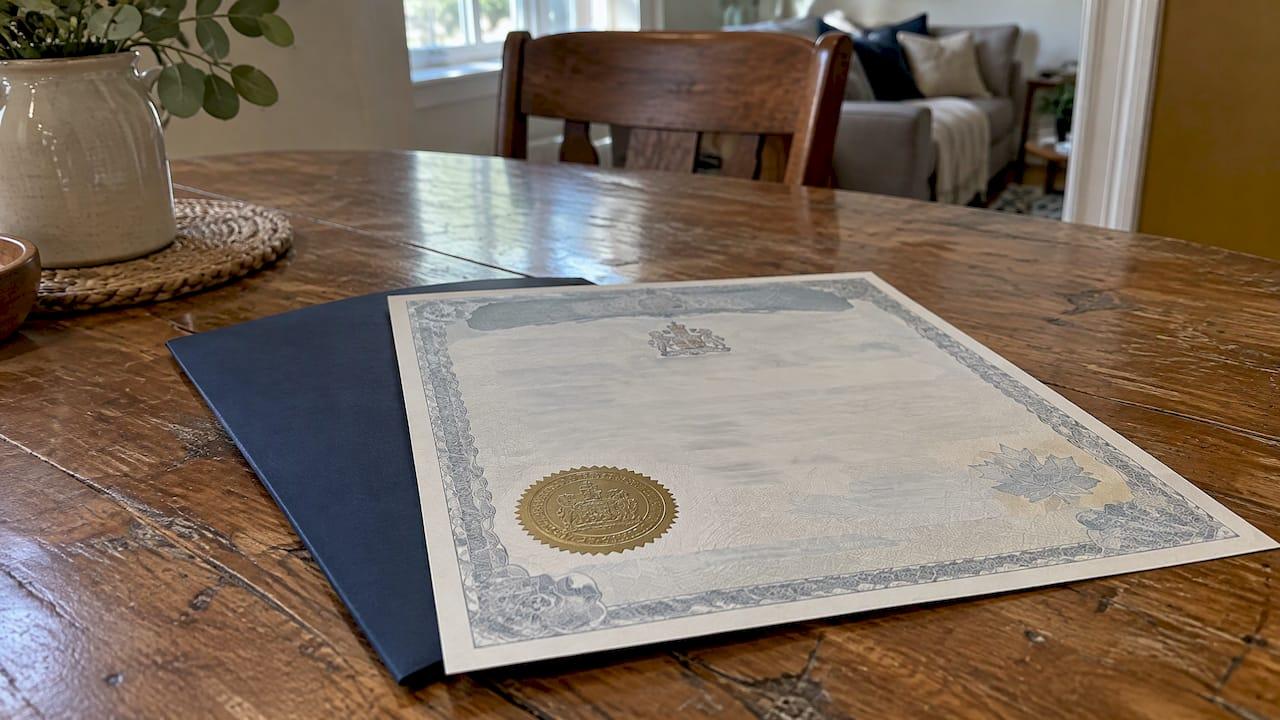
A certified copy of a birth certificate comes from the vital statistics office of the province or territory where the birth was registered. No notary can issue it, and no notary can replace it. What a notary or commissioner can do is certify a photocopy as a true copy of an original, and commission the statutory declaration some provinces ask for when you apply from outside their borders. We do both kinds of work, so this guide separates the two, because mixing them up is the most common reason people lose weeks.
If you need a certified true copy of a document you already hold, or a sworn declaration to support your application, our in-person certified true copy appointments and our $35 online declarations cover that part.
TL;DR
- A certified copy of birth registration is the long-form record issued by the province or territory of birth. It is not a photocopy and a notary cannot create it.
- Apply to the vital statistics office where the birth took place, not where you live now. Fees run from $20 to $55 or more depending on the province, plus rush options.
- Most people only need a standard birth certificate. The certified copy is for adoption abroad, some immigration or citizenship files, visas, court and consulate use.
- A certified true copy of a document you already hold, and a sworn statutory declaration for an out-of-province application, are the notarial pieces. We handle both in Ontario.
Table of Contents
- What a certified copy actually is
- Do you really need one?
- Step 1: Pick the right office
- Step 2: Confirm you are eligible
- Step 3: Apply and pay
- What it costs and how long it takes
- Where a notary fits in
- Common mistakes that cost weeks
- Our perspective
- Book the notarial step with us
- FAQ
- Sources
What a certified copy actually is
Three different things get called a "certified copy of a birth certificate", and each one is obtained differently.
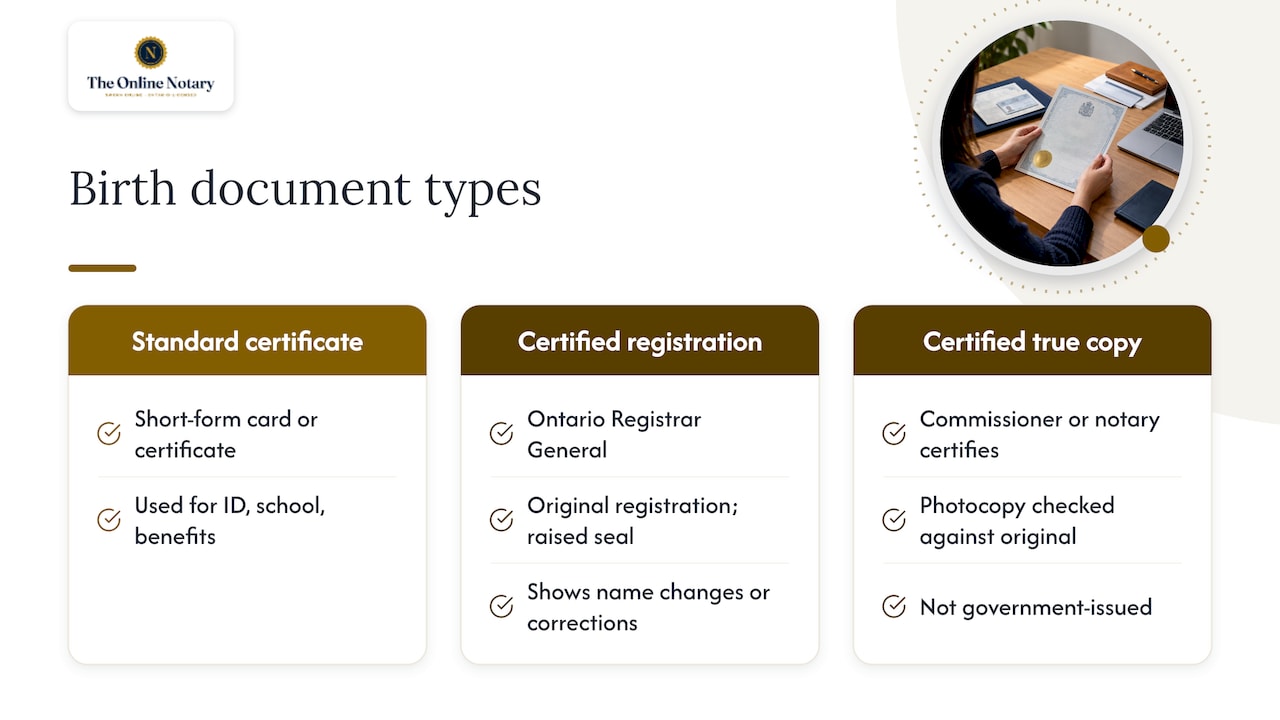
The standard birth certificate. The short-form card or certificate people use for ID, school and benefits. Several provinces say plainly that the longer registration is not for identification.
The certified copy of the birth registration. Ontario's Office of the Registrar General describes it as a copy of the original registration with all details, endorsed as authentic, printed on legal-sized paper with a raised seal, and showing any name changes or corrections. It is used where more detail is needed, such as adopting a child abroad, some immigration or citizenship applications and visa applications.
A certified true copy of your own document. This is a photocopy that a commissioner or notary compares against the original and certifies. It proves the copy matches what you hold. It does not turn into a government-issued certified copy.
The names differ by province. Ontario says "certified copy of birth registration". British Columbia uses "certified true copy of a registration" or a certified electronic extract. Alberta issues a photocopy of a Registration of Birth. Québec issues a copy of an act of birth.
Do you really need one?
Often you do not. British Columbia states that birth registrations are not used as identification and that a certified copy or electronic extract is generally required only for court or consulate purposes. Alberta says the same of its photocopy of a Registration of Birth: it cannot be used for identification and is mostly for genealogy, court or consulate needs.
For a passport, Immigration, Refugees and Citizenship Canada accepts the original birth certificate from the province or territory of birth as proof of citizenship for an adult passport, and it lists the longer province-specific documents too, including Ontario's certified copy of birth registration, BC's Certified True Copy of a Registration Document and Québec's copy of an act of birth issued after January 1, 1994.
Before you order, ask the agency that requested it which document it wants, by its exact name. Ordering the wrong version costs a fee and several weeks.
Ontario also advises keeping the long form close. Because a certified copy of birth registration holds extensive personal information, the province recommends not sharing it unless the requesting agency absolutely requires it.
Step 1: Pick the right office
Apply where the birth was registered. The federal government's guidance is that if the birth occurred in a province different from where you live, you contact the vital statistics office of the province where the birth took place. Someone born in Winnipeg and living in Toronto applies to Manitoba, not Ontario.
Step 2: Confirm you are eligible
Eligibility is set by each province's law, and it is narrower for the long-form record than most people expect.
- Ontario: you can apply for yourself if you are at least 13, for your child if you are named as a parent on the registration, or as a legal guardian with court documents. For a deceased person, only next of kin, an executor or an estate trustee or administrator can obtain a certified copy (Ontario).
- British Columbia: the subject, a parent, a custodial guardian if no parent is available, someone with written authorization, or the nearest living relative of a deceased person with proof (BC Ministry of Health).
- Alberta: the person from age 12 (ages 10 to 12 with signed parent or guardian consent), named parents, guardians, adopters, power-of-attorney holders and lawyers, among others (Alberta.ca).
- Saskatchewan: the person named, aged 15 or older, a parent listed on the registration for a child under 18, or a legal custodian or guardian (eHealth Saskatchewan).
- Québec: a parent named in the act of birth may apply regardless of the child's age. For anyone else you must show your interest with a supporting document (Directeur de l'état civil).
For older births the rules relax. Manitoba's law allows a certified copy of a birth 100 or more years ago to be issued to any person, and for more recent births it limits issue to the person, a named parent, a guardian, a written agent and a few others.
If you are applying as an agent or relative, gather the proof of authority before you start. A written authorization or court order that is missing is the usual reason an application is returned.
Step 3: Apply and pay
Most provinces take online applications. Ontario accepts online orders paid by Visa, Visa Debit, Mastercard or Debit Mastercard, and asks for a guarantor when the person on the certificate is 9 or older. You need the person's full birth details and the parents' information, and the status of your application is available one business day after you submit.
Newfoundland and Labrador is a good example of the exceptions. Its online service covers birth certificates, but certified copies of registrations for births over 100 years old must be mailed with a form, government photo ID and a $35 fee.
If you are applying from outside the province, read the application carefully. Alberta, for example, requires applicants outside the province to complete a statutory declaration before a notary or commissioner for oaths. A statutory declaration is a written statement of facts that you swear to be true in front of an authorized person. This is a step where we can help directly: if you are in Ontario, you can swear it by video with us for $35.
What it costs and how long it takes
The figures below are the published fees for the long-form or certified copy. Fees and processing times change, so confirm them on the official page before you pay.
| Province | Fee for certified copy | Timing stated by the province |
|---|---|---|
| Ontario | $35 regular online, $65 premium online or emergency in person | 15 business days plus delivery (regular), 5 business days with courier (premium) |
| British Columbia | $50 regular mail, $60 courier | Prints within 20 business days plus mailing (regular), next business day plus courier |
| Alberta | $20 government fee, plus any agent service fee | Processed within 3 business days of receipt, excluding mailing |
| Saskatchewan | $55 for the registration copy | Check the page for the current processing note |
| Québec | $46.75 online, $64.25 by mail | 10 business days; $75 online or $82.25 by mail for 3 business days |
| Manitoba | $30 per certified copy | Rush in 3 business days: $65 to Canadian addresses |
A few details matter. Ontario's replacement fees are higher than first-time orders: $45 regular and $75 for premium or emergency. Ontario's emergency in-person service is at 47 Sheppard Avenue East in Toronto. Québec accepts only Canadian-dollar payments since January 2026, and its fees are published as in effect until March 31, 2027. In British Columbia, the online ordering system adds a $33 rush option for 24 working hours of in-office processing.
Turnaround can improve. Manitoba's department told the legislature in April 2026 that the average to issue vital event certificates was eight business days after clearing a backlog. Treat any average as a guide, not a promise, and leave a buffer before a visa or adoption deadline.
Where a notary fits in
Once you hold the official document, a notarial step sometimes follows. Think of it as a separate job from getting the record itself.
A certified true copy of a document. An employer, school or agency may ask for a copy that a commissioner has certified against your original. We offer certified true copy appointments in person. Bring the original document with you.
A statutory declaration or affidavit. If your application or the requesting agency asks you to swear to facts, such as your identity or a name discrepancy, you can do it on a video call. Our affidavit and statutory declaration appointments are $35 each, with signed PDFs delivered by email. Each additional document or exhibit is $20 and each extra signer is $14.95, per our pricing page.
Travel consent for a child. Parents often need the child's birth documents and a consent letter together. The travel consent letter is also $35.
Documents going abroad. A destination country may require an apostille, a certificate that authenticates a public document for use abroad. Our Ontario apostille guide explains how the process works.
One caution from British Columbia's Legal Services Branch is worth knowing if the document is headed overseas. It authenticates only original B.C. Vital Statistics documents, and photocopies are not accepted for authentication even if notarized. A notarized photocopy is used only as a supporting document within a notarized document. So if the destination needs the birth record authenticated, order the right original first.
Common mistakes that cost weeks
- Ordering the short-form certificate when the file wants the long form, or the reverse. Read the agency's wording and match it.
- Applying to the wrong province. The record sits where the birth was registered.
- Missing the guarantor or ID. Ontario requires a guarantor for subjects aged 9 or older. Saskatchewan asks for one government-issued ID or two other IDs with a signature.
- Assuming a notarized photocopy equals the certified copy. It does not. Agencies that require the government-issued record will reject a photocopy.
- Leaving no time for rush options. Courier or premium tiers exist in several provinces, so build them into your plan if a deadline is firm.
Our perspective
People come to us expecting a notary to produce a certified copy of a birth certificate. We can't, and we say so at the start, because an honest answer saves you a week. The record belongs to the province, and the application is made to it.
What we do is the part that is quick to fix. When an agency wants a certified true copy of a document you hold, or a sworn statement to go with an application, that is a short appointment, not a trip to an office. Our licensed paralegal oversees the process, and appointments are available seven days a week from 7 am to 11 pm.
Our advice is to settle the exact document name first, then order the official record, and then book us for the sworn or certified piece so that nothing arrives at the agency half done.
Ken
Book the notarial step with us
When your file needs a sworn declaration, an affidavit or a certified true copy, we do it by video in about four minutes for the declarations, or in person for certified true copies. Declarations and affidavits are $35, and the signed PDF reaches your inbox by email after the appointment.

See the full list of documents and book at theonlinenotary.ca/documents, or check your eligibility first. If you are unsure which kind of professional signs your document, our guide on notary public or commissioner of oaths answers it.
FAQ
Can a notary give me a certified copy of my birth certificate?
Not the government-issued one. That comes only from the vital statistics office of the province or territory of birth. A notary or commissioner can certify a photocopy of your original as a true copy, which is useful for some employers and schools but is not the same as the long-form record.
How long does it take to get a certified copy in Canada?
It depends on the province and the service level. The published standards range from 3 business days (Alberta, and rush options in Québec and Manitoba) to 20 business days plus mailing for regular BC service. Check the official page for the current time before you apply.
Can I apply online?
Yes in most provinces. Ontario takes online orders by Visa, Visa Debit, Mastercard or Debit Mastercard. Some cases are the exception, such as Newfoundland and Labrador's certified copies of registrations for births over 100 years old, which must be mailed.
What if I live outside the province where I was born?
Apply to the province of birth. Some provinces add a requirement: Alberta asks applicants outside the province for a statutory declaration before a notary or commissioner for oaths. If you live in Ontario, you can complete one with us by video call.
Sources
- Get or replace an Ontario birth certificate
- Order a birth certificate or document (Alberta)
- Birth certificates (eHealth Saskatchewan)
- Application for a certificate or copy of an act of birth (Québec)
- Fees and processing time (Québec)
- The Vital Statistics Act (Manitoba)
- Fees and services (Manitoba Vital Statistics Branch)
- Manitoba Public Accounts Committee, April 17, 2026
- BC birth certificates online ordering
- Vital Statistics Division (Newfoundland and Labrador)
- Proof of Canadian citizenship for adult passports (IRCC)
- Register your child's birth (Canada.ca)