Visit an Ontario notary public or a commissioner of oaths in person, bring the original document plus a clear photocopy and valid government-issued photo ID, and expect same-day service in most cases. If your document is headed to Service Canada or IRCC, check their specific rules first, since some agencies won't accept a third-party certification at all.
TL;DR:
- Only a notary public, lawyer, or commissioner of oaths can legally certify a true copy in Ontario, with notaries being the most reliable for international use.
- Confirm the certifier accepted by the receiving institution in writing before your appointment to avoid rejected documents and wasted trips.
- Bring the original document, a clear photocopy, valid ID, and payment, ensuring the copy is legible and not a photocopy of a photocopy.
- Service Canada handles passport copies separately through in-person or mail-in channels, which can take 10 to 20 business days, and may require extra legalization for foreign use.
- Accurate preparation and adherence to the recipient's specific certification requirements are key to obtaining a valid, same-day certified true copy.
Table of Contents
- The Certified True Copy Brampton Process: What It Means and Why It's Required
- Who Can Legally Certify a Copy in Ontario?
- How Do You Get a Certified True Copy in Brampton, Step by Step?
- Special Cases: Passports, Translations, and International Use
- Preparing for Your Brampton Notary Appointment: A Checklist
- What Happens During the Appointment, and Why Copies Get Rejected
- Who's Behind This Guide: Ken and Theonlinenotary's Brampton Notary Services
- What Most Guides Get Wrong About Certified Copies
- Get Your Certified True Copy Done Right in Brampton
- Where to Confirm Official Requirements
- Sources
- FAQ
The Certified True Copy Brampton Process: What It Means and Why It's Required
A certified true copy is a photocopy that a notary public, lawyer, or commissioner of oaths has personally compared against the original and endorsed with a signature, seal, and a written certification statement confirming it's a true reproduction. That's different from notarization, which typically involves witnessing a signature on a document rather than verifying a copy against an original. It's also different from just photocopying something at a print shop, since an uncertified copy carries no legal weight with the people who ask for one.
Institutions request certified true copies constantly, and for good reason: they need proof the document in hand matches the real thing without holding onto your only original. Common situations in Brampton include:
- Immigration applications through IRCC that require supporting identity or civil status documents
- Professional licensing and credential verification, especially for internationally trained workers
- University and college admissions requiring certified transcripts or diplomas
- Government benefit applications and legal proceedings requiring proof of identity or status
Before you book an appointment, confirm exactly what the receiving institution accepts. Some organizations name a specific certifier type, and showing up with the wrong one means a wasted trip.
Who Can Legally Certify a Copy in Ontario?
Ontario recognizes several types of authorized certifiers, but they aren't interchangeable, and picking the right one up front saves you a second appointment. The most commonly accepted options include:
- Notary public: authorized to certify copies for both domestic and international use, and generally the safest choice when a document is headed outside Canada
- Lawyer: can certify copies, often as part of broader legal work
- Commissioner of oaths: can certify documents for use within Ontario or Canada, but their authority typically doesn't extend well internationally
A notary public tends to be the more reliable choice for cross-border paperwork because their certification carries more consistent recognition outside Canada, and provincial rules on who can certify vary enough that a commissioner's stamp accepted in Ontario might get questioned by a foreign consulate or an out-of-province employer.
Don't guess. If you're certifying something for an immigration file, a foreign university, or an international employer, get the receiving institution's acceptance rules in writing before your appointment. That single email can save you a repeat visit. Theonlinenotary's guide on certified copy requirements in Ontario walks through the distinctions in more detail if you want to confirm before booking.
How Do You Get a Certified True Copy in Brampton, Step by Step?
Getting a certified true copy done right on the first visit comes down to preparation. Here's the order that actually works:
- Confirm the recipient's requirements first. Call or email the institution asking for the certified copy. Ask which certifier type they accept and whether they require specific wording on the certification statement.
- Gather your originals. Bring the actual original document, not a copy of a copy. Most notaries will refuse to certify a photocopy of another photocopy, since they can't verify it against a genuine source.
- Make a clear photocopy yourself, or let the notary make one. Either works, but the copy needs to be legible with no cropped edges or faded text.
- Bring valid government-issued photo ID. A driver's license, passport, or Ontario photo card confirms your identity to the certifier.
- Bring payment. Standard certified copy fees in Ontario typically run between $20 and $50 per document, though multipage files or urgent requests can cost more.
- Sit through the verification. The notary compares your original side by side with the copy, confirms every page matches, then signs, stamps, and dates a certification statement on the copy itself.
- Walk out with your certified copy the same day. For a standard single document, there's no reason this should take more than a same-day appointment.
Pro Tip: Call ahead if you're bringing multiple documents in one visit. Some Brampton notary offices bundle multi-document fees differently than single-document rates, and knowing that upfront avoids a surprise at checkout.
Payment methods vary by provider, so ask whether the office takes debit, credit, or cash only before you show up expecting a specific option.
Special Cases: Passports, Translations, and International Use
Not every certified copy follows the standard in-person Ontario process, and this is where most people get tripped up.
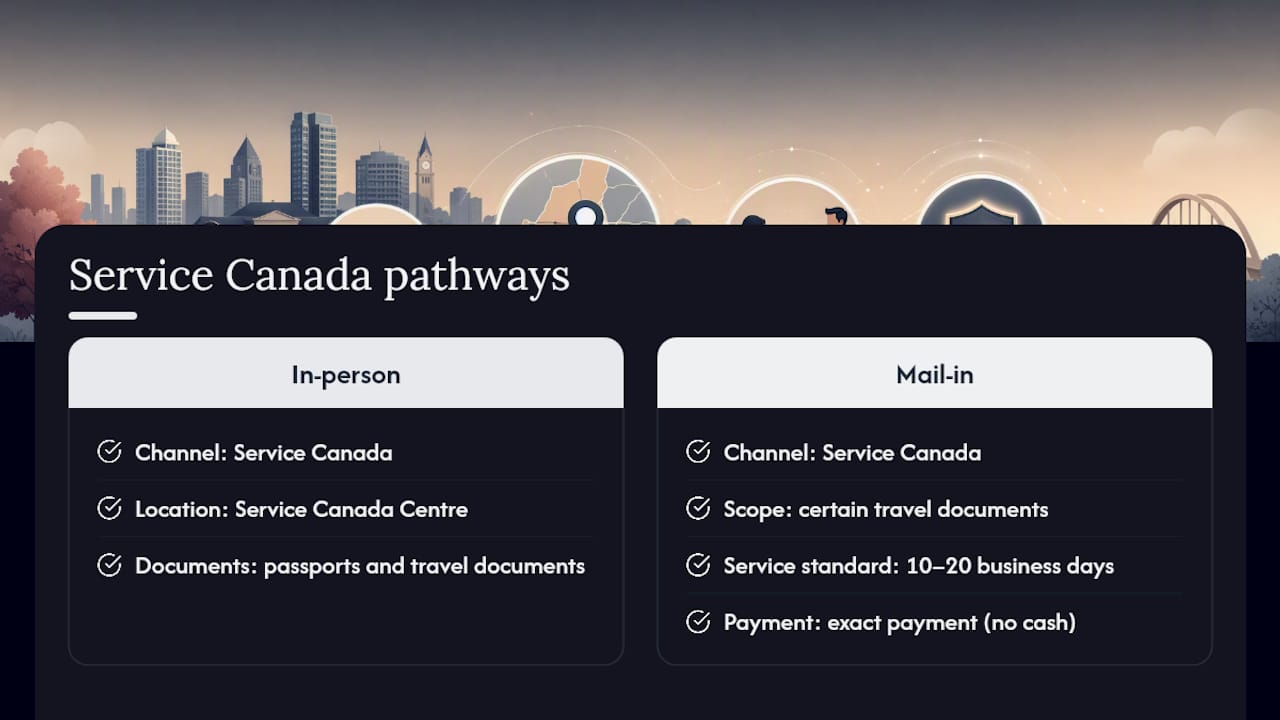
Service Canada passport copies work differently. If you need a certified true copy of a passport or travel document, Service Canada handles it through its own channel rather than a private notary. Service Canada offers both in-person processing at a Service Canada Centre and a mail-in option for certain travel documents, with mailed requests following a 10 to 20 business day service standard. Mailed applications require exact payment (no cash) and Service Canada recommends traceable courier for security.
IRCC has a specific translation rule. If a supporting document needs translation, IRCC requires that the translation be accompanied by a copy of the original, and if the translator worked from a photocopy rather than the original, that photocopy itself must be certified.
International use may require an extra legalization step. Certification alone doesn't always satisfy foreign governments. Some countries require apostille or consular legalization on top of a notarized certified copy, which is a separate process handled after certification, not instead of it.
A commissioner of oaths is usually sufficient for domestic use, but a notary public is the stronger choice the moment a document crosses a border. Digital certification tools exist for some workflows, but acceptance of electronic certified copies still depends heavily on what the recipient will accept, so confirm before relying on one.
Preparing for Your Brampton Notary Appointment: A Checklist
Repeat visits almost always trace back to the same handful of missing items. Cover these before you leave the house:
- Original document (not a photocopy of a photocopy)
- One or more clear, legible copies (or let the notary make them on-site)
- Valid government-issued photo ID matching the name on the document
- Written instructions or a contact number from the receiving institution, in case the notary needs to confirm specific wording
- Payment for the certification fee, in the method the office accepts
If your document has a name mismatch (a maiden name versus a married name, for instance), bring supporting proof like a marriage certificate. Damaged or water-stained originals can sometimes still be certified, but flag the condition with the notary before the appointment so there are no surprises.
Pro Tip: If the receiving institution gave you specific certification wording, print it out and bring it. A notary can usually adapt the standard statement, but only if they know what's required before they start stamping.
What Happens During the Appointment, and Why Copies Get Rejected
A standard certified copy appointment for a single, straightforward document runs about 10 to 20 minutes. The notary checks your ID, compares the original against the copy page by page, then signs, seals, and dates the certification statement.
Most rejections come down to avoidable mistakes:
- Bringing a copy of a copy instead of the original document
- Handing over a scan or photocopy that's blurry, cropped, or missing pages
- Using a commissioner of oaths when the recipient specifically required a notary public
- Certification wording that doesn't match what the receiving institution asked for
The notary keeps a record of the transaction, including their contact information on the certification statement itself, so the receiving institution can verify authenticity later if needed.
Who's Behind This Guide: Ken and Theonlinenotary's Brampton Notary Services
This guide was written by Ken, drawing on Ontario's official notary and commissioner requirements alongside Theonlinenotary's direct experience handling certified copy requests. Certified true copy and document notarization services are available in Brampton, along with online notary and commissioner services across Ontario for affidavits, statutory declarations, and invitation letters. Every in-person appointment follows the same verification standard laid out by Ontario notary guidelines: compare, certify, seal, and sign, with most standard document appointments completed same-day.
What Most Guides Get Wrong About Certified Copies
The advice you'll find most places treats certified copies like a one-size-fits-all errand: grab your document, find any notary, done. That's not quite right, and it's the reason so many people end up back in the same waiting room a week later.
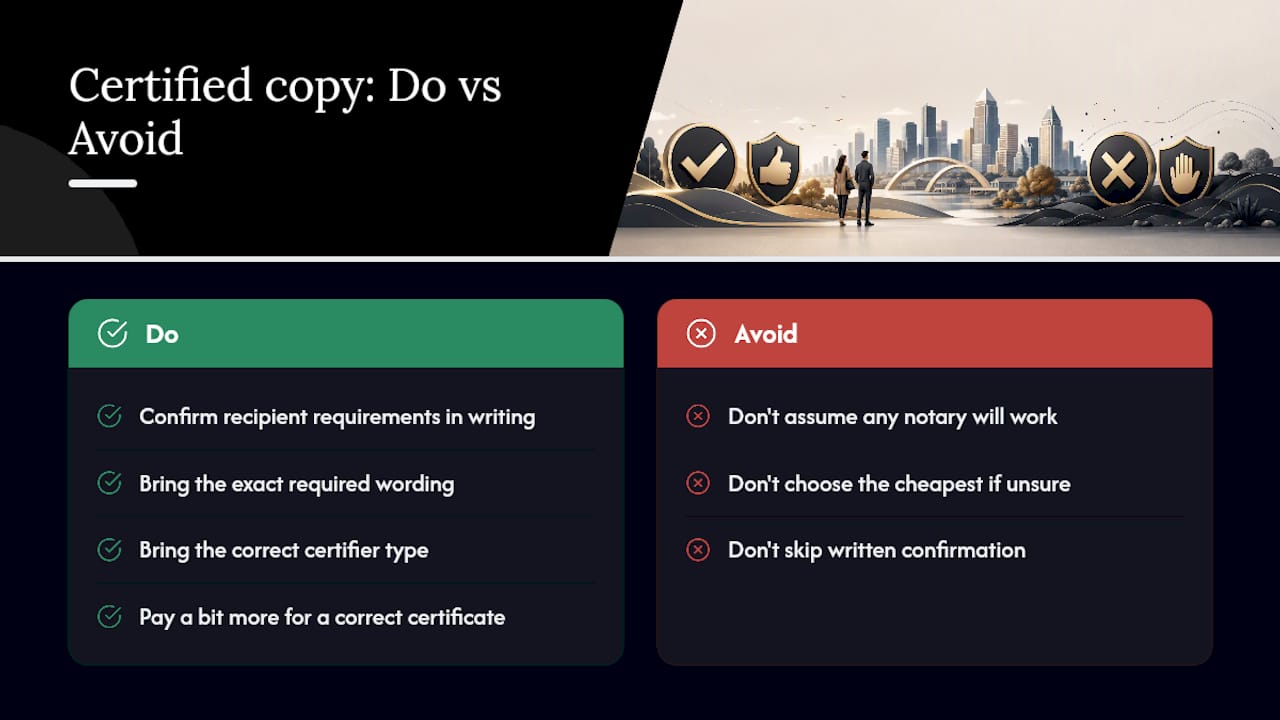
The real work happens before you ever sit down with a certifier. Confirming exactly what the receiving institution accepts, in writing, is the single step that prevents more rejected paperwork than anything the notary does at the table. A commissioner's stamp is fine for a domestic license renewal. It's a liability for an immigration file headed to another country.
I'd also push back on treating fees as the deciding factor. A $20 certification that gets rejected because it used the wrong certifier type or missing wording costs you more in lost time than paying a few dollars more somewhere that gets it right the first time. Speed matters in Brampton, where same-day turnaround is realistic, but only if you walk in prepared. Preparation, not the price tag, is what actually determines whether you leave with a usable document.
— Ken
Get Your Certified True Copy Done Right in Brampton
Certified true copies can be handled in-person in Brampton, plus online notary and commissioner services are offered across Ontario for affidavits, declarations, and invitation letters that often travel alongside those certified documents. That combination means you're not juggling two providers when a single visa or licensing file needs both a certified copy and a sworn affidavit.

Both walk-in and scheduled appointments are available, but booking ahead means your notary can confirm the receiving institution's exact wording requirements before you arrive, cutting a 20 minute visit down even further. Check what your recipient accepts, then book your Brampton notary appointment to get your certified true copy the same day.
Where to Confirm Official Requirements
Before you finalize any certified copy, verify the details directly with the source. Check Service Canada's certified true copy guidance for passport-specific rules, Justice Canada's attestation resources for the legal basis of document certification, and always confirm acceptance requirements with the specific institution requesting your document.
Sources
- Canada
- Justice
- Certified True Copies Ontario | Requirements & Process
- What Is a Certified True Copy? (Canada Guide for 2026) | Professional Interpreting Canada
FAQ
How Can I Obtain a Certified True Copy in Ontario?
Bring the original document, a clear photocopy, and valid photo ID to a notary public, lawyer, or commissioner of oaths, who will compare the copy against the original and endorse it with a signature, seal, and certification statement.
How Much Does a Certified True Copy Cost?
Standard certified copy fees in Ontario typically range from $20 to $50 per document, though multi-page or urgent requests can run higher.
Who Can Issue a Certified True Copy?
In Ontario, a notary public, lawyer, or commissioner of oaths can issue one, though a notary public is generally the safer choice for documents used outside Canada.
How Do You Certify a Document as a True Copy?
The certifier physically compares the copy to the original page by page, then signs, dates, and seals the copy with a statement confirming it's a true and accurate reproduction. Theonlinenotary's Brampton office follows this exact process for walk-in and scheduled appointments.