

A corporate statutory declaration in Ontario is a solemn written statement that must use the prescribed Canada Evidence Act wording and be declared before an authorized officer, such as a commissioner for taking affidavits or a notary public. The single action that matters most: confirm the exact form the recipient requires and book that appointment before anyone signs a thing.
TL;DR:
- Most corporate statutory declarations in Ontario must be commissioned during a live, in-person or video session, with proper identification confirmed on the spot.
- Using outdated, foreign, or improperly formatted templates often leads to rejection, emphasizing the need for exact wording and the correct jurat language.
- The commissioning process must follow a precise sequence: prepare facts first, then sign during the appointment, whether in person or via real-time video.
- Remote commissioning has become permanent and requires specific conditions, including real-time audiovisual connection and confirmation of voluntary signing at both physical locations.
- Online commissioning services help avoid common errors, such as signing prematurely or forgetting the remote-specific jurat language, ensuring compliance and record-keeping.
Table of Contents
- What Counts as a Corporate Statutory Declaration in Ontario
- Who Can Commission a Statutory Declaration in Ontario
- How Remote Commissioning Works Under O. Reg. 431/20
- When Corporations Actually Need One (and When They Don't)
- A Practical Checklist and Model Wording
- The Mistakes That Get Declarations Rejected
- What I've Learned Commissioning These for Ontario Businesses
- Book an Online Commissioning Appointment With Theonlinenotary
- Primary Sources Worth Bookmarking
- Sources
What Counts as a Corporate Statutory Declaration in Ontario
A statutory declaration is a written statement a declarant swears to be true outside a courtroom, using specific wording set out in the Canada Evidence Act. It differs from an affidavit mainly in purpose. An affidavit is built for litigation and gets filed with a court; a statutory declaration serves administrative and business purposes, like confirming a corporate fact for a registry, a bank, or a government office. Both require an authorized officer, and both carry legal consequences for lying.
Ontario corporations rely on statutory declarations for several recurring jobs:
- Confirming signing authority or officer identity for a bank or lender
- Attesting to lost or destroyed share certificates
- Supporting amalgamation, dissolution, or continuance filings
- Verifying facts in a transaction where no other document exists
The Canada Business Corporations Act confirms that declarations and affidavits can exist as electronic documents when signed with a secure electronic signature, which matters once you get into remote commissioning below.
Who Can Commission a Statutory Declaration in Ontario
Not every professional who stamps documents can take your declaration. O. Reg. 386/12 splits authorized officers into two groups: those who are commissioners by virtue of their office (judges, lawyers, paralegals, and certain government officials) and those individually appointed as commissioners for taking affidavits. Notaries public form a separate category with broader authentication powers.
A few practical wrinkles trip people up:
- Lawyers and paralegals often commission without a physical stamp, since their authority comes from their professional license, not an appointment certificate
- Appointed commissioners carry a Notice of Approval with an expiry date, so an expired commission voids the declaration
- Notaries public can authenticate documents for use outside Ontario in ways a plain commissioner cannot
Pro Tip: If your commissioner has no stamp, that alone doesn't disqualify the document. Call the receiving organization first and ask whether they'll accept a declaration commissioned by a lawyer acting by virtue of office.
How Remote Commissioning Works Under O. Reg. 431/20
Ontario made virtual commissioning permanent through O. Reg. 431/20, and corporate officers use it constantly now instead of driving to a law office. The regulation sets three conditions that a valid remote statutory declaration process has to meet.
- Live two-way audio-visual technology connects the declarant and the officer in real time; a recorded video sent afterward does not qualify.
- The officer sees acceptable identification during the same live session and confirms the declarant is signing voluntarily and with direct knowledge of the facts.
- The jurat gets modified to state that commissioning happened remotely, list both physical locations, and confirm compliance with O. Reg. 431/20.
Before you rely on this route, check that the recipient actually accepts remotely commissioned declarations. Some registries, older lenders, and foreign authorities still expect an in-person signature, and a handful require a notary specifically because notarial acts carry stronger recognition abroad, a point covered well in this guide on when you need a statutory declaration.
When Corporations Actually Need One (and When They Don't)
Officers reach for a statutory declaration far more often than they reach for an affidavit, mostly because declarations fit administrative situations without the overhead of a court proceeding.
- Confirming who holds signing authority when a bank's records are out of date
- Declaring a share certificate lost, ahead of reissuing one
- Supporting a Corporations Canada filing like amalgamation, where the model statutory declaration already provides sample wording
- Attesting facts in a transaction that has no other paper trail
An affidavit becomes the right tool once litigation, a court filing, or a formal dispute is involved. If your declaration needs to travel outside Canada, for example to support a foreign subsidiary's registration, a notary public is usually the better choice over a plain commissioner, since notarization carries more weight with foreign registries and apostille processes.
A Practical Checklist and Model Wording
Before the appointment, gather three things: proof of the declarant's identity, confirmation of exactly which form the recipient wants, and evidence the declarant has direct personal knowledge of the facts being declared. Officers commissioning corporate declarations reject a surprising number of drafts simply because the declarant grabbed a template from another province.
At the appointment itself, nothing gets signed until the officer is watching, whether that's in person or over live video. The officer stamps or signs, records the remote details if applicable, and confirms the jurat language matches what the recipient expects.
| Element | What it needs to say |
|---|---|
| Declarant identification | Full legal name, corporate title, and capacity to declare |
| Statement of facts | Direct knowledge only, no hearsay or assumptions |
| Jurat (in person) | "Declared before me at [city], Ontario, this [date]" |
| Jurat (remote) | Adds both locations and a statement of compliance with O. Reg. 431/20 |
| Officer signature block | Name, title, and commission or notary details |
For corporate filings specifically, Corporations Canada's model statutory declaration is the cleanest starting point, since it already matches the wording Corporations Canada expects for amalgamation and related filings. Adapt the facts section to your own circumstances rather than copying boilerplate wholesale.
The Mistakes That Get Declarations Rejected
Most rejected declarations share the same handful of causes. Declarants sign before the officer is present, which voids the whole document since the signature has to happen during the declaration, not before it. Others use wording lifted from a different province's template, or they forget the modified jurat language O. Reg. 431/20 requires for remote sessions.
- Signing ahead of the appointment instead of in front of the officer
- Missing the remote commissioning statement in the jurat
- Using an out-of-province or outdated template
- Never confirming the recipient's exact format requirements beforehand
Pro Tip: Email the receiving organization a draft before your appointment and ask them to confirm it's acceptable. A five-minute email saves a second commissioning appointment.
Keep a signed copy, the officer's commission details, and any correspondence confirming acceptance in your corporate records. Falsely declaring facts is not a paperwork slip. Under the Canada Evidence Act framework, a knowingly false statutory declaration can trigger Criminal Code consequences for perjury or making a false statement.
What I've Learned Commissioning These for Ontario Businesses
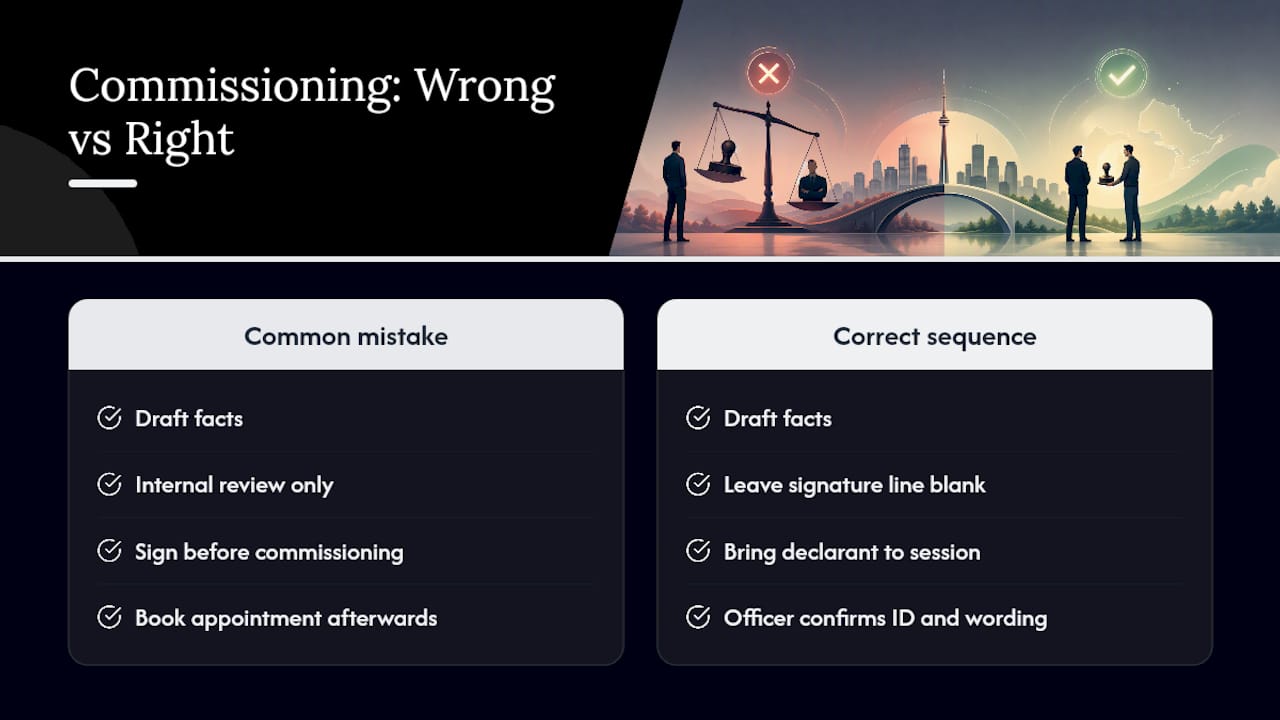
Most corporate declaration problems have nothing to do with the law and everything to do with sequencing. Officers draft the document, get it "reviewed" internally, then sign it before ever contacting a commissioner. By the time they book an appointment, the declaration is already invalid, and nobody notices until a bank or registry kicks it back weeks later.
The fix is almost embarrassingly simple: treat the commissioning appointment as the first live event, not the last formality. Draft the facts, leave the signature line blank, and bring the declarant to the session ready to sign only after the officer confirms identity and reviews the wording. Remote commissioning under O. Reg. 431/20 has made this faster for Ontario businesses, but it hasn't changed the sequence. If anything, it's made rushing more tempting because the whole thing can happen from a desk. Resist that. A ten-minute video call done right beats a same-day rejection every time.
— Ken
Book an Online Commissioning Appointment With Theonlinenotary
An online service provides a faster route to a compliant corporate statutory declaration for Ontario businesses that don't want to book a law office visit or guess at O. Reg. 431/20 wording themselves. Every remote session runs on live audio-visual technology, includes identity checks during the call, and produces a jurat with the required compliance language and location details.

Corporate officers use such services because they can help reduce sequencing mistakes that cause rejections, such as signing before the appointment, missing jurat clauses, or uncertainty about whether a recipient accepts virtual commissioning. Declarations are checked for wording and structure before commissioning, and a stamped, dated record is provided for the corporate file.
If your business needs a corporate statutory declaration commissioned this week, review pricing and availability for online notary services and book a session that fits your schedule.
Primary Sources Worth Bookmarking
- Canada Evidence Act statutory declaration wording — statute
- Corporations Canada model statutory declaration — official template
- O. Reg. 386/12, commissioners for taking affidavits — statute
- Business Corporations Act, R.S.O. 1990, c. B.16 — statute
Sources
- Model of statutory declaration
- Canada Business Corporations Act - Justice Laws Website
- O. Reg. 386/12 COMMISSIONERS AND OTHER PERSONS WHO MAY TAKE AFFIDAVITS
- Statutory Declaration Ontario: When You Need One (2026)