

No, the Immigration, Refugees and Citizenship Canada (IRCC) rulebook does not universally require a notarized invitation letter. Notarization is optional in most family and friend visitor cases. It can help in specific situations: applicants from countries with high refusal rates, business visitor invitations, or when a particular visa office says so directly.
- IRCC does not universally require notarization for a letter of invitation; it is optional for most family and friend visits.
- Notarization adds credibility in higher-scrutiny cases but never guarantees visa approval on its own.
- Your next move: check the visa office instructions for the applicant's country. If nothing is specified, notarize anyway and pair it with strong supporting documents.
Bottom line: a notarized letter strengthens a weak file marginally. It does nothing for a file that's missing dates, proof of ties, or financial evidence. Get the substance right first.
Key Takeaways
Notarization strengthens an invitation letter's credibility but never substitutes for complete host and guest details, supporting documents, and a clear purpose of visit.
| Point | Details |
|---|---|
| Notarization is optional | IRCC does not universally require it; check the applicant's visa office for exceptions. |
| Completeness beats formality | Include host and guest names, dates, addresses, relationship, and travel dates before worrying about a seal. |
| Notarize for higher-risk files | Business invitations and applications from high-refusal-rate countries benefit most from notarization. |
| Prepare before you sign | Gather ID, proof of status, and financial documents, and leave the letter unsigned until you're in front of the notary. |
| Theonlinenotary handles remote sessions | Theonlinenotary offers online notarization in Ontario with ID verification and same-day certified PDF delivery for invitation letters. |
Table of Contents
- What Does IRCC Actually Require in a Canada Invitation Letter?
- When Does Notarizing an Invitation Letter Actually Help?
- How Do You Notarize an Invitation Letter in Ontario and Canada?
- What Should Your Invitation Letter Checklist Include?
- What Supporting Documents Should You Attach and How Do You Submit Them?
- How Does The Online Notary Help With Invitation Letters?
- Is Notarization Overrated or Underrated for Canadian Visitor Visas?
- Where Should You Book a Notarized Invitation Letter in Ontario?
- Sources
What Does IRCC Actually Require in a Canada Invitation Letter?
IRCC's own guidance on the letter of invitation for visitors to Canada treats it as a supporting document, not a legal contract. Notarization isn't part of the official checklist. What matters is completeness: a visa officer needs enough detail to verify who's inviting whom, and why.
For the host in Canada, IRCC expects:
- Full legal name, date of birth, and current address
- Canadian citizenship or permanent residency status, with a copy of a passport or PR card
- Telephone number and job title or occupation
For the visiting guest, include:
- Full legal name, date of birth, and passport number
- Home country address and exact travel dates
- Relationship to the host, and the purpose and length of the visit
Skip any of these and the letter reads as thin, no matter how official the paper looks.
When Does Notarizing an Invitation Letter Actually Help?
Notarization earns its place in a handful of scenarios, not every visitor visa file. It matters most for applicants from regions with elevated refusal rates, for official business invitations, and any time a visa office spells out that it wants a notarized letter for business visitors specifically.
What notarization actually does: it verifies the signer's identity and confirms the signature happened in front of a licensed professional. That's a credibility signal for officers reviewing a file with limited context. It is not a substitute for proof that the visitor has ties to their home country, income, or a return plan.
- Business visitor letters sometimes require notarization by explicit visa office policy, and companies should prepare two originals.
- Applicants from higher-refusal-rate countries benefit from the extra formality.
- If the visa office instructions mention notarization at all, treat it as mandatory for that file, even if IRCC's general page doesn't.
Pro Tip: Before you notarize anything, search the applicant's specific visa office or VAC page by country. A generic "no notarization needed" answer online won't override what a particular office actually asks for.
How Do You Notarize an Invitation Letter in Ontario and Canada?
Here's the exact sequence, whether you go in person or book a remote session.
Preparation, before you touch a notary:
- Draft the letter but leave it unsigned. Signing has to happen in front of the notary, not before.
- Gather your ID: a valid passport or driver's license.
- Pull your proof of status: PR card, Canadian passport, or citizenship certificate.
- If you're promising financial support, have your Notice of Assessment (NOA) or an employment letter ready.
In-person notarization steps:
- Find a licensed notary public or commissioner of oaths near you.
- Bring your ID and the unsigned letter.
- Sign the letter in the notary's physical presence.
- Confirm the notary applies an embossed seal and their signature, and request two original signed copies.
Online notarization (widely available in Ontario):
- Book a secure video notary session.
- Complete remote identity verification, usually a government ID plus a live check.
- Sign on camera while the notary observes in real time.
- Receive a certified PDF showing the notary's credentials, digital seal, and a notarial statement.
Whichever route you take, ask the notary to include their full contact details, an embossed stamp or digital certificate, a declaration confirming you signed in their presence and affirmed the letter's contents are true, and the date. In Ontario, in-person notarization typically runs same-day if you book ahead, while remote sessions often close out within an hour once your documents are ready. Fees vary by provider and document complexity, so confirm pricing before booking rather than assuming a flat rate.
What Should Your Invitation Letter Checklist Include?
Bring this list to your notary appointment rather than improvising on the spot.
Host section:
- Full name, date of birth, and Canadian address
- Immigration status with a copy of supporting ID
- Job title, employer, and phone number
- A specific sentence on financial support if you're covering costs ("I will cover accommodation and daily expenses for the duration of the visit.")
Guest section:
- Full name, date of birth, and passport number
- Home address and exact arrival/departure dates
- Relationship to host, explained in one clear sentence
- Stated purpose of the visit, matching what's on the visitor's own application
For deeper phrasing help, our step-by-step drafting guide for Ontario walks through sample sentences line by line.
Formatting basics:
- Prepare two signed originals, not one.
- Write dates in full (e.g., "March 12, 2026") to avoid confusion between date formats.
- Leave a line for the notary's signature and seal, separate from your own signature.
- Label any attached documents clearly.
Common pitfalls: vague trip length ("a few weeks"), no proof of the host-guest relationship, and travel dates that don't match the flight itinerary or supporting bank records. Any one of these can undercut a letter that's otherwise notarized perfectly.
What Supporting Documents Should You Attach and How Do You Submit Them?
The letter alone rarely carries a visitor visa application. Officers want a paper trail that backs up every claim in the letter.
Attach copies of:
- The host's passport or PR card
- A recent CRA Notice of Assessment or employment letter
- Bank statements showing financial capacity
- Lease or mortgage documents confirming address
- Proof of relationship, such as a marriage certificate, family photos, or an affidavit for proof of relationship
When you scan and upload the notarized letter, make sure the image is high resolution and captures the raised embossing or digital seal clearly. Low-quality scans that hide the seal are a common reason officers flag a file for follow-up. Name your files so an officer can match them instantly, something like "Host_NOA_2025.pdf" rather than "scan1.pdf". Upload everything through the applicant's online TRV portal, and carry two original signed copies with you when traveling since border services officers can request them at the port of entry.
How Does The Online Notary Help With Invitation Letters?
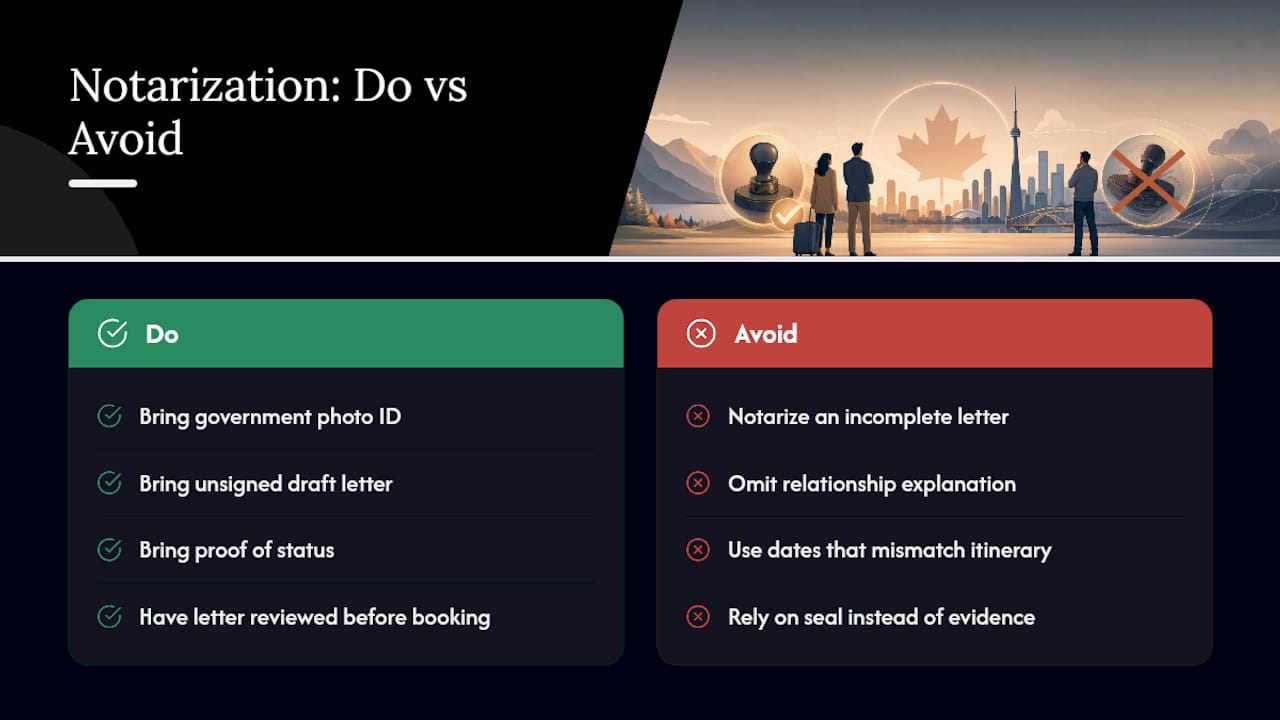
We handle remote online notarization for hosts across Ontario, built specifically around documents like invitation letters, affidavits, and statutory declarations. That means ID verification, a document review before you sign, and a certified PDF delivered with a visible digital seal, often same-day.
What to bring to your appointment: a government-issued photo ID, your unsigned draft letter, and any proof of status you're referencing inside the letter. The most common mistake we see is applicants notarizing a letter that's missing a relationship explanation or has mismatched dates against the traveler's itinerary, exactly the kind of gap our rejection-pitfalls guide covers in detail.
A notarized letter with a seal but no relationship proof or financial backup does not fix a weak visitor visa application. The seal verifies your signature, not your case.
Pro Tip: Have your letter drafted and reviewed before you book. Sessions move faster when the notary isn't also acting as your editor.
Is Notarization Overrated or Underrated for Canadian Visitor Visas?
Most guides online treat notarization as either mandatory or pointless. Both are wrong. The research points to something more useful: notarization is a credibility multiplier, not a credibility source. It amplifies a file that already has solid proof of ties, finances, and a coherent story. It does nothing for a file that's missing those things.
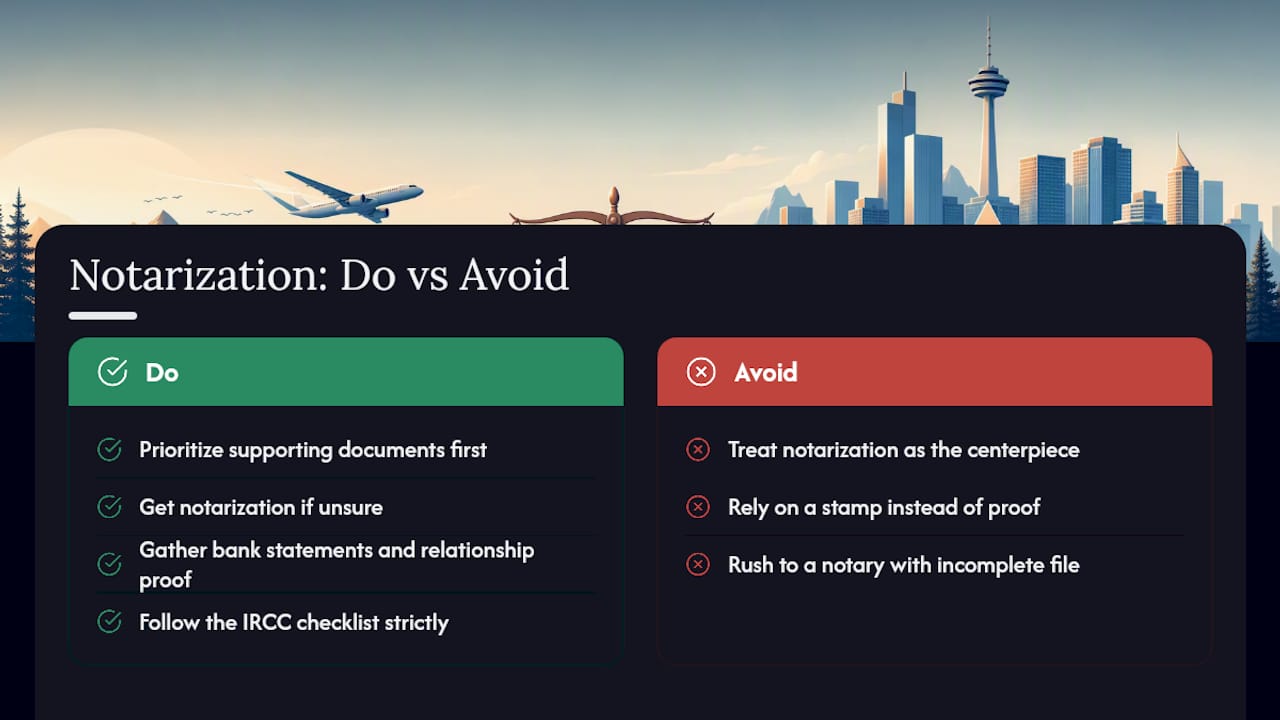
Where conventional advice falls short is in treating the letter as the centerpiece of the application. It isn't. The IRCC checklist for what to include matters more than whether a stamp appears on the page. I'd rather see a host spend an extra hour gathering bank statements and a clear relationship explanation than rushing to a notary with a half-finished letter.
If you're uncertain whether your case needs notarization, default to getting it done anyway; the cost is small, and the downside of skipping it when a visa office expects it is a processing delay you can't undo. Prioritize the paperwork trail first, the seal second.
— Ken
Where Should You Book a Notarized Invitation Letter in Ontario?
If you've been weighing a law office visit against a courier trip to a commissioner of oaths, there's a faster route that fits an invitation letter's timeline better than either. Theonlinenotary handles the entire notarization by secure video, so you're not driving across Ontario or waiting days for an in-person slot during a season when visa deadlines rarely wait.

We built this specifically around documents hosts actually need fast: invitation letters, affidavits, and statutory declarations, with ID verification and a certified PDF that shows the notary's seal clearly enough for a visa officer to see it on first look. That last part matters more than most hosts realize since poor scan quality is a real reason letters get flagged.
If your applicant has a deadline coming up, book a session through our notary services page and get your letter signed, sealed, and delivered as a certified PDF the same day.
Sources
- Canada
- How to Get a Letter of Invitation Notarized for a Canadian TRV | Canada Lawyer Directory
- Invitation Letter for Canada Visa: What to Include & Sample | ImmiTime
Recommended
- The Essential Guide to Invitation Letter Requirements Canada - The Online Notary
- Invitation Letter for Visa: Complete Guide for Ontario - The Online Notary
- How to get a notarized application letter in Ontario 2026 - The Online Notary
- Notarized Documents for Immigration: Ontario Guide 2026 - The Online Notary