

In Ontario, a will does not have to be notarized to be valid. It has to be signed and witnessed in exactly the right way, and that is where most home-made wills go wrong. What people usually mean by a "notary for wills" is a licensed professional who watches the signing, confirms who you are and makes sure the formalities are met. We offer that as specialist will witnessing, from $99 CAD, and this guide explains what the law asks for and what to prepare so your will holds up when your family needs it.
TL;DR
- Ontario does not require a will to be notarized or filed with a court. It requires your signature at the end and two witnesses present at the same time.
- Most will problems come from signing and witnessing mistakes, not from the lack of a notary stamp.
- Ontario permanently allows wills to be witnessed by video, as long as at least one witness is a lawyer or paralegal licensed by the Law Society.
- Our specialist will and power of attorney witnessing starts from $99 CAD. Standard $35 CAD commissioning is for affidavits and declarations, not wills.
- Quebec is different: it has a true notarial will, drawn up by a notary.
Table of Contents
- Does a will need to be notarized in Ontario?
- What makes a will valid in Ontario
- Can you write your own will in Canada?
- Who can witness a will, and what is a notary's role?
- Notarial wills in Quebec: where a notary really does the job
- Ontario notary, commissioner of oaths and paralegal: which is which
- How will witnessing works with us
- What happens after you sign
- Why use a licensed professional rather than two friends
- Why we recommend a supervised signing
- Book your will witnessing
- FAQ
- Sources
Does a will need to be notarized in Ontario?
No. Steps to Justice, run with Ontario court services, states that you do not need to have your will commissioned or notarized, and you do not need to file it with a court or government office. A formal will is signed in front of two witnesses who also sign. A holograph will, written entirely in your own handwriting and signed, is the other recognized form.
So why do so many people search for a notary? Three reasons come up again and again:
- They have seen a stamp on other documents, such as affidavits and travel consent letters, and assume a will works the same way.
- They want someone who knows the rules to watch the signing, so nobody can question it later.
- They live in another country or province where a notary plays a bigger role in wills.
The second reason is the sound one. A will is rarely read until the person who made it can no longer explain what they meant. A signing that was supervised by a licensed professional leaves far fewer questions.
What makes a will valid in Ontario
The rules sit in Ontario's Succession Law Reform Act (SLRA). Subject to a few exceptions, such as military wills and holograph wills, a will is not valid unless:
- it is signed at its end by you, or by another person in your presence and on your direction;
- you make or acknowledge your signature in front of two or more witnesses who are present at the same time; and
- those witnesses then sign the will in your presence.
Each of those points is a place where something can go wrong. Here is what we see people get wrong on paper, and how to avoid it.
Signing in the wrong place
The signature belongs at the end of the will. Text added below it, or pages signed out of order, can raise questions. Sign after the last line of the document and keep the final page from being a signature page on its own, so that it is clear it belongs to the rest.
Witnesses who are not together
The law asks for both witnesses to be present at the same moment when you sign or acknowledge your signature. Signing for one witness on Monday and another on Friday is the classic way to produce an invalid will.
Witnesses with an interest in the will
The SLRA has rules about witnesses who receive a gift under the will, or whose spouse does. Choose witnesses who gain nothing from it. A neighbour or colleague is usually safer than a family member. Check the current text of the Act or ask your will professional if you have any doubt.
Changes after signing
Handwritten edits, crossed-out lines and swapped pages after the signing can undermine the document. The Law Society of British Columbia's 2026 wills guide warns lawyers that missing attachments, alterations and erasures can affect validity. It also notes that doubt about due execution, such as a will-maker printing their name instead of signing, can mean extra evidence is needed in court. That guide is written for British Columbia, but the lesson holds everywhere: a clean, complete signing is the cheapest protection a will can have.
Can you write your own will in Canada?
Yes. Ontario recognizes both the witnessed formal will and the holograph will written wholly in your own hand. The formalities are the same whether you used a template or a professional. A homemade will is not invalid because you made it yourself. It is invalid when a formality is missed.
If something does go wrong, Ontario has a safety valve. Since January 1, 2022, section 21.1 of the SLRA lets the Superior Court of Justice validate a writing that was not properly executed if it sets out the deceased's testamentary intentions. It applies only where the person died on or after that date, and it cannot be used for electronic wills. It is a court application, though, which means cost, delay and uncertainty for your family. Getting the signing right the first time avoids all of that.
Who can witness a will, and what is a notary's role?
In Ontario, any two adult witnesses who do not benefit from the will can meet the basic test. A notary stamp is not part of it. What changes the picture is when you want:
- someone who confirms your identity properly;
- someone who knows the signing rules and will stop the ceremony if a witness or page is wrong; or
- a signing by video, because you or your witnesses cannot be in the same room.
That last case matters most. Under SLRA s. 4(3) and (4), in force since April 7, 2020 and amended May 20, 2021, remote witnessing of a will by audio-visual technology is permanently allowed if at least one witness is a licensee under the Law Society Act, meaning a lawyer or a paralegal. The signing and witnessing must happen at the same time, and signatures can be made on complete, identical counterpart copies.
That is why the professional matters. Video witnessing is not something two friends can set up between themselves. A licensed professional is built into the requirement. Our own guide, can a will be signed online in Ontario, walks through how this works in practice.
Notarial wills in Quebec: where a notary really does the job
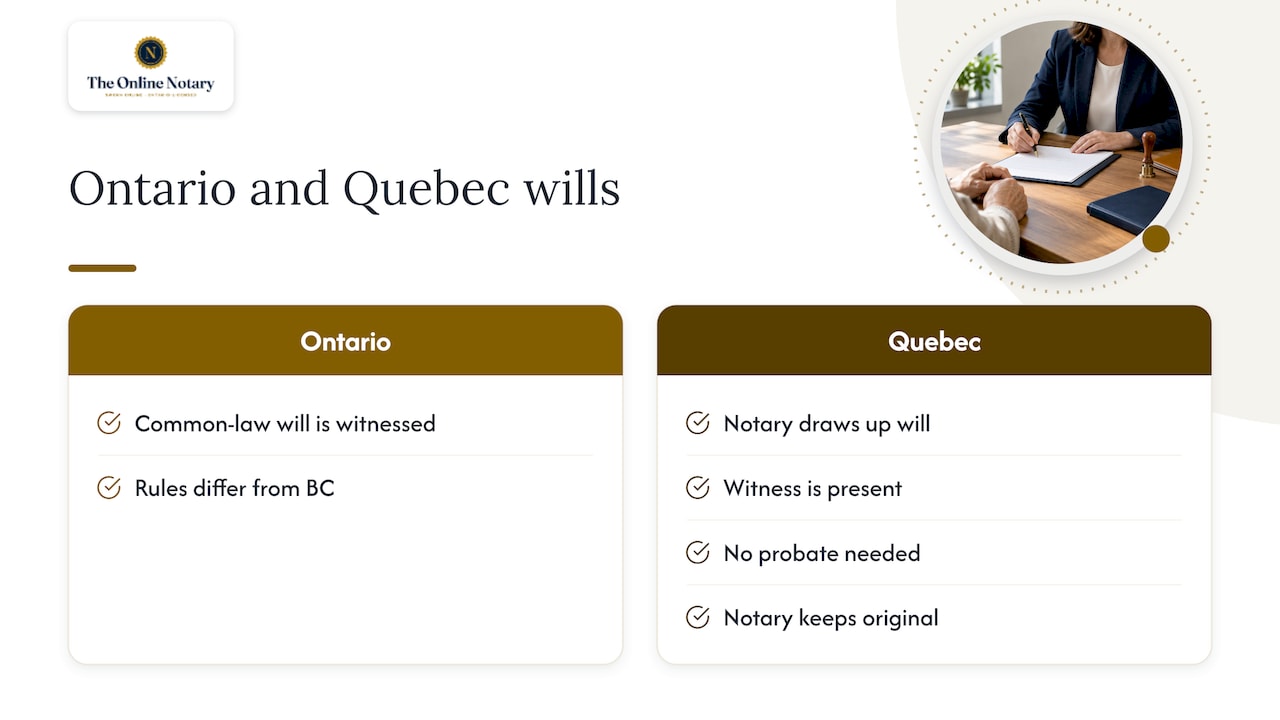
The phrase "notary for wills" comes from places where notaries do far more than stamp. In Quebec, the government recognizes three forms of will: notarial, holograph and witnessed. A notarial will is drawn up by a notary and made in the presence of a witness. It does not need to be probated, and the notary keeps the original.
According to the Gouvernement du Québec, a notarial will is difficult to challenge because the notary checks identity, capacity and free and informed consent, and registers it in the Chambre des notaires' register. If you live in Quebec, that is the route those rules describe.
In the common-law provinces, including Ontario, British Columbia and Manitoba, a will is a witnessed document. Clicklaw, from the People's Law School, confirms for British Columbia that the will does not need to be notarized. It also notes that since December 1, 2021 a BC will can be signed and stored electronically. These rules differ from Ontario's, so do not assume a rule you read about another province applies to your signing.
Ontario notary, commissioner of oaths and paralegal: which is which
The titles are confusing, so here is the short version:
| Role | What it does | Typical use |
|---|---|---|
| Commissioner of oaths | Administers oaths and takes declarations | Affidavits, statutory declarations |
| Notary public | Certifies documents and signatures, can certify true copies | Documents going to other offices or countries |
| Licensed paralegal or lawyer | Law Society licensee, who can serve as the required witness for remote will signing | Wills and powers of attorney witnessing |
Our guide on notary public or commissioner of oaths explains the difference in more detail. For a will, the title on the stamp matters less than the licence behind the person witnessing it.
One point of confusion is worth clearing up. People often book a $35 CAD affidavit appointment hoping it will cover a will. It does not. Affidavits and statutory declarations are sworn documents. A will is witnessed by two people at the same time under the SLRA. They are different procedures, and the will gets the specialist treatment.
How will witnessing works with us
We handle wills and powers of attorney as a specialist witnessing service, priced separately from our everyday documents. It starts from $99 CAD, with the full pricing on our pricing page. A few things we list there that apply to a signing:
- Each extra signer costs $14.95 CAD.
- Each additional document or exhibit costs $20 CAD.
So a couple who each sign a will and a power of attorney should look at the pricing page to see how the extras add up before booking. A signing with several documents costs more than a single will, and the figures there are the ones to rely on.
Our team is led by licensed paralegal Ken Gogna, and you can read more about the people behind it on our notaries page. Appointments run seven days a week from 7 am to 11 pm, which helps when your witnesses work office hours and the only time everyone can be present together is an evening or a Sunday.
Before your signing
- Finish the will first. Read it through and make sure every page is there. Do not sign in advance, and do not sign anything before the appointment.
- Line up your witnesses. Remember, two witnesses must be present at the same time. Choose people who gain nothing from the will.
- Have photo ID ready. Our guide on what ID you need for a notary lists what is accepted.
- Check eligibility. Not every document or situation suits a video appointment. Our eligibility checker takes a minute.
- Book. Pick a time when every signer can be on camera at once.
Powers of attorney
Many people sign a power of attorney alongside a will, since both are about planning for the future. We witness these as part of the same specialist service. Our documents page lists what we handle, and the cost for an extra signer or document is shown on the pricing page.
What happens after you sign
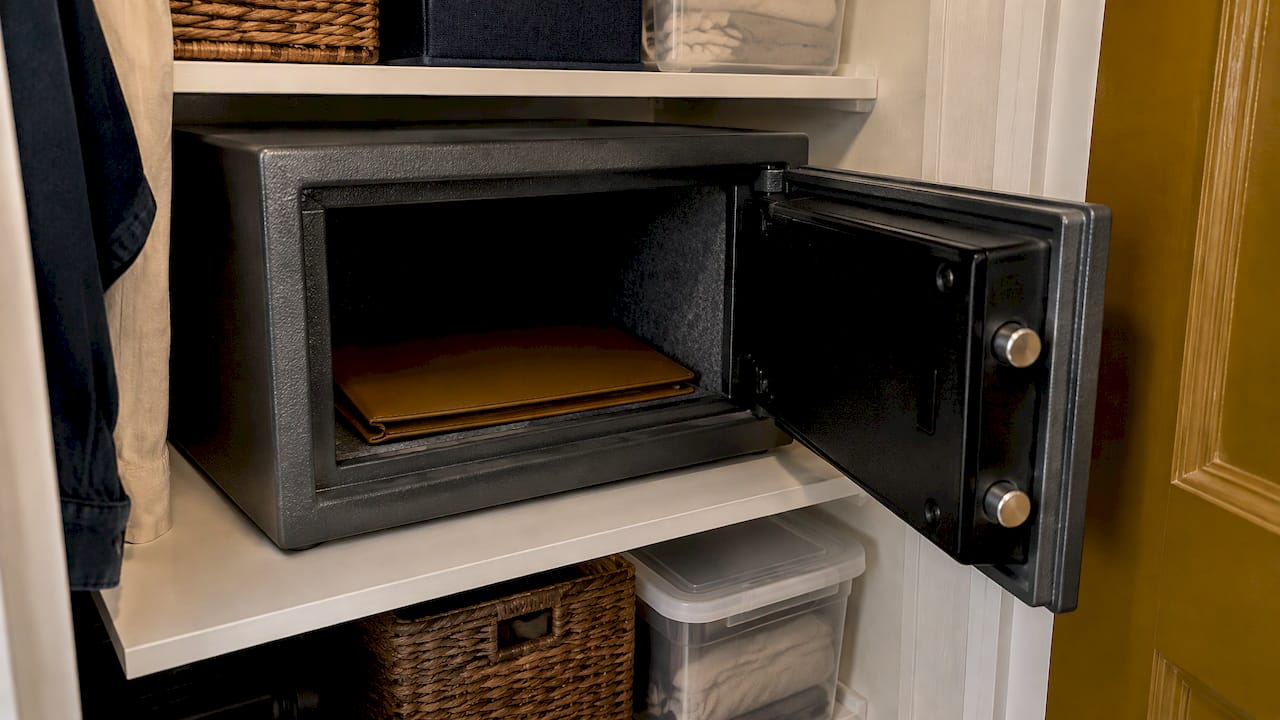
Store the original will in a safe, known place, such as a fireproof box at home or with the lawyer who drafted it. Tell your executor where it is. Ontario does not require filing the will with any government office, so the original is what counts, and a lost original can cause real trouble later.
If you ever change your will, do not scribble on the old one. Make a new will or a properly signed codicil, witnessed with the same formalities. A fresh signing is simpler than trying to rescue a marked-up page.
Probate is a separate step after death. In Ontario, the executor applies to the court for a certificate that confirms the will. If you want advice on your estate plan, tax or how to divide assets, speak to a lawyer. Witnessing a signing is not the same as drafting or advising on your will.
Why use a licensed professional rather than two friends
Two friends in a living room can make a valid will. Plenty of people have. The difference is what happens when something is off. A neighbour does not usually know to stop and redo a page, to check that nobody beneficiary-adjacent is signing, or to keep a clean record of how the signing went.
With a licensed witness, you get someone whose job is the process. If you are signing from another city, from a hospital room or from abroad, the remote option under the SLRA exists precisely because a Law Society licensee is part of it. In practice, that means a will signed by video can meet the same formal standard as one signed in person.
Why we recommend a supervised signing
A will is a document your family reads at the worst possible time. They cannot ask you what you meant, and they cannot ask whether the signing went well. All they have is the paper.
That is why we treat will witnessing as its own service rather than a quick stamp. We are Ontario-licensed professionals, led by a licensed paralegal, and the law gives Law Society licensees a specific role in witnessing wills, including remotely. Our everyday appointment takes about four minutes. A will signing takes the time it needs, because the point is to get every formality right once.
If you are signing a will, a power of attorney or both, we would rather you book a proper signing with the right witnesses present than discover a problem years later. Bring your ID, your finished documents and your witnesses, and we will take it from there.
Ken
Book your will witnessing
If you have a finished will or power of attorney and want it witnessed by a licensed Ontario professional, our specialist witnessing starts from $99 CAD. Each extra signer is $14.95 CAD and each additional document or exhibit is $20 CAD. See the pricing page for the full details and to book.

For the lower-cost documents that often go with an estate or travel plan, such as affidavits, statutory declarations and travel consent letters, the standard $35 CAD appointment is on our documents page.
FAQ
Do I need a notary to make a will in Ontario?
No. Ontario court services confirm that a will does not need to be commissioned or notarized. It needs your signature at the end and two witnesses present at the same time, who also sign. A licensed professional witness helps make sure each of those steps is done correctly.
Can a will be signed by video call in Ontario?
Yes. The Succession Law Reform Act permanently allows remote witnessing of wills by audio-visual technology, provided at least one witness is a lawyer or paralegal licensed under the Law Society Act. The signing and witnessing must happen at the same time. You can read more in our guide on signing a will online in Ontario.
How much does will witnessing cost?
Our will and power of attorney witnessing starts from $99 CAD. Each extra signer is $14.95 CAD and each additional document or exhibit is $20 CAD. The full list is on our pricing page.
Is a handwritten will valid in Canada?
In Ontario, a holograph will, written completely in your own handwriting and signed, is recognized. Manitoba also allows holograph wills, and Quebec recognizes them as one of its three forms. The rules differ by province, so check the one where you live.
Sources
- Decide how you want to make your will, Steps to Justice
- Succession Law Reform Act, R.S.O. 1990, c. S.26, ontario.ca
- Wills 2026, Law Society of British Columbia
- Forms of will, Gouvernement du Québec
- Notarial will, Gouvernement du Québec
- How do I make a will? Clicklaw