An oath and an affirmation carry identical legal weight in Canada. Neither one gives you a legal advantage or disadvantage. The Canada Evidence Act framework and the Oaths of Allegiance Act treat both as producing the same binding obligation, and a false affirmation exposes you to perjury exactly as a false oath does. So pick whichever one matches your conscience. No court, immigration office, or employer can penalize you for choosing the secular option.
Key Takeaways
Oaths and affirmations carry identical legal force in Canada, so your choice comes down to personal conscience rather than legal consequence.
| Point | Details |
|---|---|
| Same legal effect | The Canada Evidence Act and Ontario procedural guidance confirm oaths and affirmations create identical obligations. |
| Perjury applies equally | Lying under either an oath or an affirmation exposes you to the same perjury consequences. |
| No justification needed | Ontario guidance confirms you don't need to prove a religious objection to affirm instead of swear. |
| Administrators vary by context | Judges, commissioners, notaries, and citizenship officials each handle different oath or affirmation settings. |
| Ontario documents go remote | Theonlinenotary offers remote commissioning and notarization for affidavits and declarations across Ontario. |
Table of Contents
- Oath vs Affirmation: The Core Difference in Wording
- Does an Affirmation Carry Less Legal Weight Than an Oath?
- Where Will You Actually Encounter an Oath or Affirmation?
- How to Make an Oath or Affirmation in Canada: Step by Step
- Getting Documents Sworn or Affirmed in Ontario
- Get Your Oath or Affirmation Handled Online in Ontario
- Frequently Asked Questions
- Sources
Oath vs Affirmation: The Core Difference in Wording
An oath is a solemn promise that typically invokes a religious authority, most commonly the phrase "so help me God," or a promise sworn on a religious text.
An affirmation is a solemn promise that carries the same commitment to truthfulness, minus any religious language. You state that you "solemnly, sincerely, and truly affirm" instead of swearing.
- Oaths and affirmations use different words and, sometimes, different physical gestures (raising a hand, holding a text).
- Both create the exact same legal duty to tell the truth or fulfill the promise made.
- Neither format changes how a court, tribunal, or government office treats the resulting document or testimony.
- You do not owe anyone an explanation for choosing to affirm rather than swear.
Pro Tip: You don't need to prove a religious objection to affirm. Ontario's own procedural guidance for oath administrators confirms that personal preference is enough — you just say the word "affirm" instead of "swear" when the administrator asks.
Does an Affirmation Carry Less Legal Weight Than an Oath?
No. This is the single most common misconception people bring into a courtroom or a notary's office, and the law is unambiguous on the point. Ontario's Treasury Board Secretariat guidance for oath administrators states plainly that oaths and affirmations produce the same obligations and responsibilities, including identical exposure to perjury charges for lying under either one.
The Oaths of Allegiance Act (R.S.C., 1985, c. O-1) supplies the federal statutory backbone for oaths of allegiance while explicitly recognizing solemn affirmation as a lawful alternative wherever the law permits it. That statute, combined with the Canada Evidence Act's evidentiary rules, means a witness who affirms in an Ontario courtroom faces the same criminal exposure for perjury as one who swears on a Bible.
Legal commentary tracing the history of affirmation shows it was introduced precisely to close this gap, so that people who could not in good conscience swear a religious oath would not be shut out of court testimony, public office, or citizenship. Modern statutes have since put the two on essentially equal footing, and courts have followed suit.
Courts and tribunals generally accept affirmations as having the same legal effect as oaths, and while a tribunal may set its own procedure, an individual's right to choose their preferred method remains protected.
If you falsely affirm a statement in an affidavit or on the witness stand, you can be charged with perjury under the Criminal Code just as surely as if you had sworn on a religious text. The word choice never changes the stakes.
Where Will You Actually Encounter an Oath or Affirmation?
You'll run into this choice in a handful of predictable Canadian settings, and knowing who administers each one helps you prepare.
Citizenship ceremonies. A citizenship official presides, and every new citizen recites the same official wording, choosing "swear" or "affirm" as they go.
Court testimony. A judge or court clerk administers the oath or affirmation to witnesses before they give evidence.
Public office. New public servants in Ontario take an Oath or Affirmation of Office and Allegiance, administered internally, with narrow exemptions available if taking the oath could jeopardize a person's citizenship in another country.
Affidavits and statutory declarations. A commissioner for taking affidavits or a notary public administers the jurat, the certification clause confirming you swore or affirmed before them, as explained in detail by Notary Services Dubai | Document Attestation & Notary | Goodhand.
Tribunals and administrative hearings. Adjudicators often set their own local procedure but generally honor the same choice.
The official Citizenship Oath wording, used at every ceremony across the country, makes the equivalence explicit in its own text:
How to Make an Oath or Affirmation in Canada: Step by Step
The mechanics are nearly identical whether you're in a courtroom, a citizenship ceremony, or a notary's home office over video call.
- Prepare the document unsigned. If you're swearing to an affidavit or statutory declaration, do not sign it before you meet the official. Signing early invalidates the jurat.
- Bring valid government ID. The administering official has to confirm you are who you say you are.
- Meet the authorized official. This might be a judge, a court clerk, a commissioner for taking affidavits, a notary public, or a citizenship official, depending on the context.
- State your choice: swear or affirm. You are not required to explain your reasoning either way.
- The official completes the jurat or attestation. This certification, not the specific wording you used, is what gives the document its evidentiary weight.
Who can do what differs slightly. A commissioner for taking affidavits can administer oaths and affirmations but cannot notarize a document, while a notary public can do both, which matters if you need a certified true copy alongside your sworn statement.
- A sworn jurat typically reads: "Sworn before me at the City of Toronto, in the Province of Ontario..."
- An affirmed jurat reads the same way, substituting "Affirmed" for "Sworn," with no other change to legal effect.
Pro Tip: If you're booking a remote appointment, confirm the commissioner or notary's remote commissioning process in advance and have your original, physical ID ready for the video call. A photo of your ID on a phone screen usually isn't accepted.
Choosing to swear or affirm: what actually matters
Your decision usually comes down to personal comfort, not legal strategy. Consider your own religious or secular convictions first. If you're appearing remotely, affirmation tends to be operationally smoother since it removes any need for a religious text or physical prop that can be awkward to present on camera. Indigenous individuals and members of other faith traditions sometimes have their own customary forms recognized by specific tribunals, so it's worth asking the receiving authority if you're unsure.
The one scenario worth pausing on: if you hold foreign citizenship and worry that swearing an oath of allegiance could create a conflict under that other country's law, raise it with the administering office beforehand. Outside of edge cases like that, nobody needs to justify affirming over swearing, or vice versa.
Getting Documents Sworn or Affirmed in Ontario
If you're preparing an affidavit, statutory declaration, or solemn declaration in Ontario, the checklist is short:
- Gather valid photo ID and leave your document unsigned until you're in front of the official.
- Book an appointment with a commissioner for taking affidavits or a notary public.
- Confirm the receiving court, agency, or employer will accept the document in its intended format.
- Notaries can notarize and commission; commissioners can only commission.
- Remote commissioning is permitted in Ontario under specific technology and identification rules.
- Always confirm acceptance requirements with the receiving authority before your appointment, since some agencies still expect specific formatting.
Pro Tip: Ask your commissioner or notary which video platform and ID verification steps they use for remote sessions before you book, so you're not troubleshooting technology minutes before your appointment.
A practitioner's take on the swear-or-affirm question
The equivalence isn't a technicality. It's the entire point of the statute. Whether you swear or affirm, confirm your remote commissioning rules ahead of time and keep original ID within reach.
Get Your Oath or Affirmation Handled Online in Ontario
Booking an in-person appointment for a five-minute jurat is often the slowest part of the whole process. Theonlinenotary handles affidavits, statutory declarations, solemn declarations, and invitation letters remotely, so you can swear or affirm from home instead of driving across town and sitting in a waiting room.

Every session is conducted by a licensed commissioner or notary who accepts either format, oath or affirmation, and issues a properly completed jurat that receiving authorities in Ontario recognize. If you need a certified true copy alongside your sworn statement, the notary designation covers that too, which a commissioner alone cannot do. Before you book, double check with your court, immigration office, or employer that they accept remotely commissioned documents. Once you've confirmed that, you can book your appointment through Theonlinenotary's services page and have your document sworn or affirmed the same day.
Frequently Asked Questions
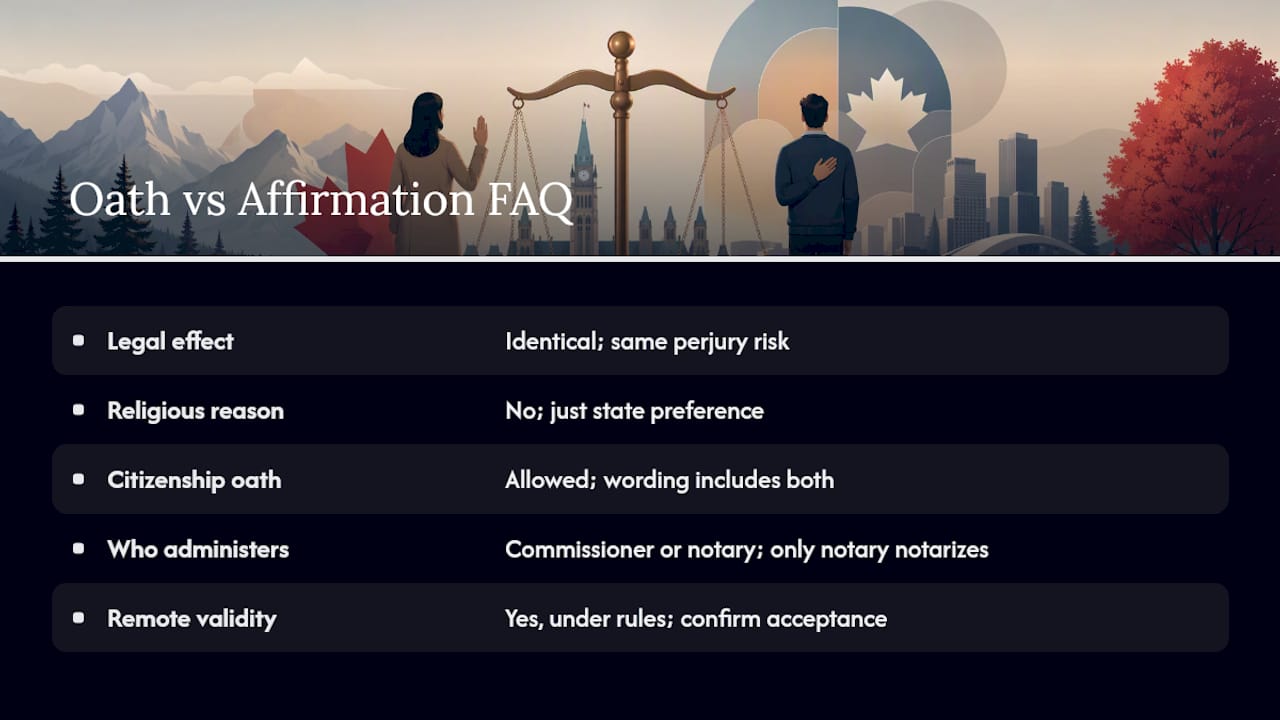
Is an affirmation legally weaker than an oath in Canada? No. Ontario procedural guidance and federal statutes both confirm oaths and affirmations produce identical legal obligations, including equal exposure to perjury for false statements.
Do I need a religious reason to choose affirmation over an oath? No. Modern Canadian practice, including Ontario's own oath administrator guidance, does not require you to justify or prove any objection to swearing. You simply state your preference.
Can I affirm instead of swear at my Canadian citizenship ceremony? Yes. The official Citizenship Oath wording explicitly includes "I swear (or affirm)," and IRCC treats both choices as equally valid for becoming a citizen.
Who can administer an oath or affirmation for an affidavit in Ontario? A commissioner for taking affidavits or a notary public can administer both. Only a notary public can also notarize the document itself.
Are remote oaths and affirmations valid in Ontario? Yes, under specific rules. Remote commissioning is permitted for many documents, though you should confirm your receiving court, agency, or employer accepts remotely commissioned paperwork before booking.
What happens if I lie after affirming rather than swearing? The same thing that happens if you lie after swearing. Perjury law applies identically to both, since the affirmation carries the same binding legal weight as an oath.
This article is general information, not a substitute for advice from a qualified lawyer. Consult a qualified legal professional about your own circumstances before acting on anything here.
Sources
For readers who want to verify any of this directly, these primary sources cover the legal ground in more depth.
The Oaths of Allegiance Act (R.S.C., 1985, c. O-1) sets out the federal statutory framework. IRCC's Oath of Citizenship page provides the official ceremony wording and confirms swearing and affirming carry equal standing. Ontario's Treasury Board Secretariat oath administrator guidance explains procedural rules and exemptions for public-office oaths. The Law Society of Ontario's guidance on commissioners and notaries explains who can administer what, and the British Columbia Provincial Court's page on oaths and alternatives shows how one province's courts apply the same principle in practice. If you're drafting a document that will need one of these, Theonlinenotary's guide on how to prepare a valid affidavit in Ontario walks through the drafting steps that precede the jurat itself.
- Oaths and Affirmations of Office and Allegiance: Instructions for Oath Administrators (Ontario Treasury Board Secretariat)
- Oaths of Allegiance Act (R.S.C., 1985, c. O-1) - Justice Canada
- Commissioner for taking affidavits and Notary public - Law Society of Ontario
- Oaths and alternatives - Provincial Court of British Columbia