

Ontario permits remote witnessing of wills. The law is settled, not experimental: Bill 245 made virtual execution a permanent option, not a pandemic workaround. But "permitted" doesn't mean "anything goes." Three conditions have to line up before a remotely witnessed will holds up.
- The signing happens over live audio-visual technology, with everyone watching in real time.
- Signatures are contemporaneous, meaning the testator and both witnesses sign during the same virtual session, and those signatures go on paper in wet ink.
- At least one witness must be a licensee of the Law Society of Ontario, either a lawyer or a paralegal.
Electronic signatures don't count for wills in Ontario, full stop. If you're planning a remote will witnessing Ontario appointment, everything below tells you why these rules exist, how practitioners run the sessions, and what can go wrong if you skip a step.
Key Takeaways
Remote will witnessing is legal in Ontario under Bill 245, but it only holds up when audio-visual presence, contemporaneous wet-ink signing, and a Law Society licensee witness all happen together.
| Point | Details |
|---|---|
| Bill 245 is the legal basis | It permanently amended the SLRA and SDA to allow audio-visual witnessing of wills and POAs. |
| Wet ink is still mandatory | Electronic signatures do not satisfy the statutory requirement for wills in Ontario. |
| A licensee witness is required | At least one witness must be an LSO lawyer or paralegal, not just any adult. |
| Affidavits protect the estate | An Affidavit of Execution commissioned after signing smooths the later probate application. |
| Theonlinenotary runs compliant sessions | Its remote appointments pair a licensee witness with identity checks and post-signing affidavit commissioning. |
Table of Contents
- What Makes Remote Will Witnessing Legal in Ontario?
- Counterpart or Circulation: How the Signing Actually Happens
- Your Checklist for a Compliant Remote Will Signing
- When Remote Witnessing Isn't the Right Call
- How Theonlinenotary Handles Remote Will Witnessing Appointments
- What Ontario's Rules Get Right, and Where They Fall Short
- Get Your Will Witnessed Remotely, Without the Waiting Room
- Frequently Asked Questions
- Sources
What Makes Remote Will Witnessing Legal in Ontario?
Bill 245, the Accelerating Access to Justice Act, 2021, received Royal Assent on April 19, 2021, and it amended two statutes that govern this area: the Succession Law Reform Act (SLRA) and the Substitute Decisions Act (SDA). Before that, Ontario's temporary pandemic orders allowed virtual witnessing on an emergency basis, and lawyers spent a stressful stretch of time figuring out how to make that work in practice, as Canadian Lawyer Magazine documented at the time. Bill 245 took that temporary fix and wrote it into permanent law.
The Law Society of Ontario's own guidance spells out the operating conditions. Audio-visual technology satisfies the "presence" requirement in the SLRA and SDA only when at least one witness is an LSO licensee and every signature is contemporaneous with the video session, not signed later and mailed in.
A will signed on video is only as strong as its paper trail. If the testator signs alone after the call ends, or a witness adds their signature the next day, the "contemporaneous" requirement breaks, and so does the will's validity.
Three things to keep straight when reading the statute:
- Wet ink still governs. Ontario has not extended e-signature validity to wills, even with a licensee watching over video.
- The licensee-witness rule is not optional. A remote will with two lay witnesses and no lawyer or paralegal in the room fails the LSO's own standard.
- Regulations layer on top of statute. O. Reg. 431/20 governs remote commissioning of oaths and declarations, which matters once you need an affidavit of execution notarized after the fact.
Counterpart or Circulation: How the Signing Actually Happens
Practitioners run remote will signings one of two ways, and the choice affects how airtight the contemporaneity claim is later.
- Counterpart method: everyone joins the same video call, each person has an identical printed copy in front of them, and the testator and both witnesses sign their own copy during the live session. The signed pages get combined afterward into one instrument.
- Circulation method: the testator signs first, and the document (or a copy) gets sent on to witnesses who sign afterward, sometimes on a separate call.
Circulation raises harder questions about what "contemporaneous" actually means when the witnesses aren't watching the testator's pen hit paper in the same moment. That's a large part of why many practitioners default to counterpart signing for wills specifically. It leaves less room for a probate court to ask uncomfortable questions later. Powers of attorney see more flexibility in practice, partly because the stakes around later disputes tend to be lower than with a will.
Camera setup matters more than people expect. Every page needs to be visible on screen as it's signed, not just the signature line, and the lawyer witness typically walks through each page before anyone signs anything.
Pro Tip: Ask the supervising licensee to keep a written log of the call, timestamps included, noting who signed what and when. If the will is ever challenged, that log is often more persuasive than memory.
Your Checklist for a Compliant Remote Will Signing
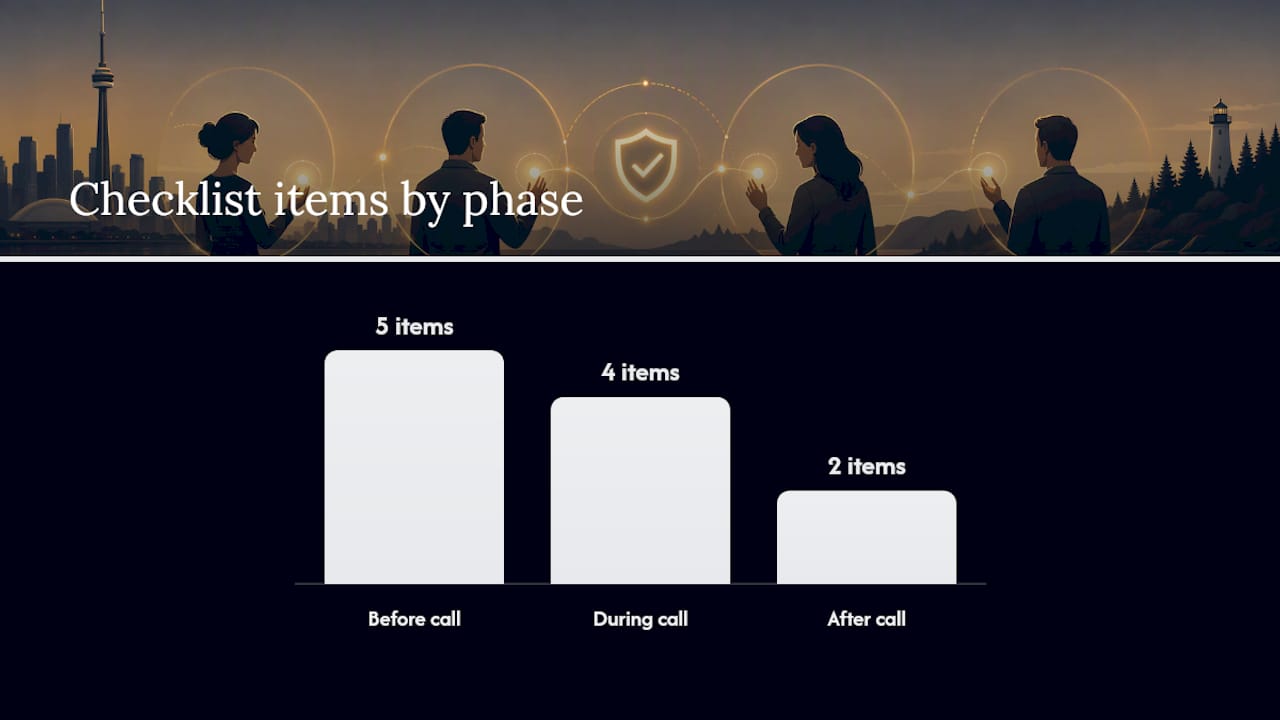
A remote will signing has three phases, and skipping a step in any of them is what creates problems at probate.
Before the call:
- Confirm the final version is printed and identical for the testator and each witness.
- Have government-issued photo ID ready to show on camera.
- Test your camera, microphone, and internet connection at least a day ahead.
- Confirm your witnessing lawyer or paralegal has scheduled enough time; rushing invites mistakes.
- If there's any doubt about the testator's mental capacity, raise it with the supervising licensee before the call starts, not during it.
During the call: 6. Everyone shows valid photo ID to the camera before anything else happens. 7. The licensee walks through every page of the will on screen. 8. The testator signs in wet ink while the witnesses watch live. 9. Both witnesses sign their own copies within the same session.
After the call: 10. The witnessing licensee commissions an Affidavit of Execution (Form 74.8), which the estate trustee will need for probate. 11. Signed pages get assembled into one complete original and stored securely, often with the law firm or a safety deposit box.
Skip step 10 and you've created a headache for whoever applies for probate later. An affidavit of execution is the paper proof that the signing followed the rules.
When Remote Witnessing Isn't the Right Call
Not every situation belongs on a video call. A handful of red flags should push you toward in-person execution instead.
- A testator with fluctuating or uncertain cognitive capacity, especially if there's no recent medical assessment on file.
- Family tension over the will's contents, where someone could later claim undue influence.
- A shaky internet connection or a testator uncomfortable with the technology, which invites signing errors.
- Any beneficiary present in the room or visible on camera during the signing, which can taint the process even if unintentional.
Weak identity verification or a sloppy affidavit is exactly what gives a disgruntled family member grounds to challenge a will at probate. The LSO's own guidance leans hard on documentation for this reason.
Pro Tip: If anything feels off during the call, a good witnessing lawyer will pause and reschedule rather than push through. That instinct protects the will more than any checklist does.
How Theonlinenotary Handles Remote Will Witnessing Appointments
Theonlinenotary builds its remote will witnessing sessions around the same conditions the LSO lays out: a licensed witness on every call, identity checks before signing, and contemporaneous wet-ink execution watched live, not reviewed after the fact.
- A pre-appointment check confirms document readiness and flags capacity concerns before the call is even booked.
- Identity verification happens on camera, matching government ID against the person signing.
- An LSO licensee witnesses the signing live and commissions the affidavit of execution once the will is signed.
- Original pages get assembled and instructions provided for safekeeping ahead of a future probate application.
The paperwork after the call matters as much as the call itself. A will without a properly commissioned affidavit of execution puts extra work on whoever has to prove it in probate court.
For readers weighing whether a power of attorney needs the same treatment, the process runs on similar rules, detailed further in this guide to power of attorney notarization in Ontario. Book a session through Theonlinenotary's services page to get started.
What Ontario's Rules Get Right, and Where They Fall Short
Bill 245 solved the right problem: it stopped forcing frail or isolated testators to gather three people in one room during a health crisis, and it kept that flexibility once the crisis passed. That's a genuinely good piece of lawmaking.
Where the conventional advice falls short is in treating remote witnessing as a technology question. It isn't. The camera and the internet connection are the easy part. The hard part is judgment, whether the supervising licensee is willing to stop a call the moment something feels wrong with capacity or pressure from a family member in the next room. No checklist substitutes for that instinct, and no statute can legislate it.
If you're an Ontario resident weighing this option, prioritize the witness, not the platform. Ask who is witnessing before you ask how the call will run. A licensed lawyer or paralegal who takes the affidavit of execution seriously is worth more than any amount of technical polish. The document you're signing will likely be read years from now by people who weren't on the call, and the paper trail is what speaks for you then.
Get Your Will Witnessed Remotely, Without the Waiting Room
Theonlinenotary handles remote will witnessing for Ontario residents who'd rather not coordinate three schedules and drive across town to sign a document. Every session pairs you with an LSO licensee witness, walks through identity verification on camera, and ends with a properly commissioned affidavit of execution, the exact paperwork your estate trustee will need at probate.

If you've read this far, you already know the requirements: audio-visual presence, wet-ink signatures, a licensed witness. That's precisely how Theonlinenotary structures every appointment, so nothing gets left out that could cause trouble later. Compare your options on the best online notary solutions page, or go straight to booking a remote will witnessing appointment and get it scheduled this week.
Frequently Asked Questions
Is remote will witnessing actually legal in Ontario, or just tolerated? It's fully legal. Bill 245 made it permanent law by amending the SLRA and SDA, not a temporary allowance that could be pulled back.
Can I use an e-signature instead of printing and signing by hand? No. Wills in Ontario still require wet-ink signatures even when the witnessing happens over video.
Does the witness have to be a lawyer? At least one of the two witnesses must be an LSO licensee, either a lawyer or a paralegal. The second witness can be any competent adult who isn't a beneficiary.
What happens if my witnesses sign on different days? That likely breaks the contemporaneity requirement and puts the will's validity at risk. Signatures need to happen during the same live session.
Do I still need an affidavit after a remote signing? Yes. An Affidavit of Execution, commissioned by the witnessing licensee, is what your estate trustee will typically need to move the will through probate smoothly.
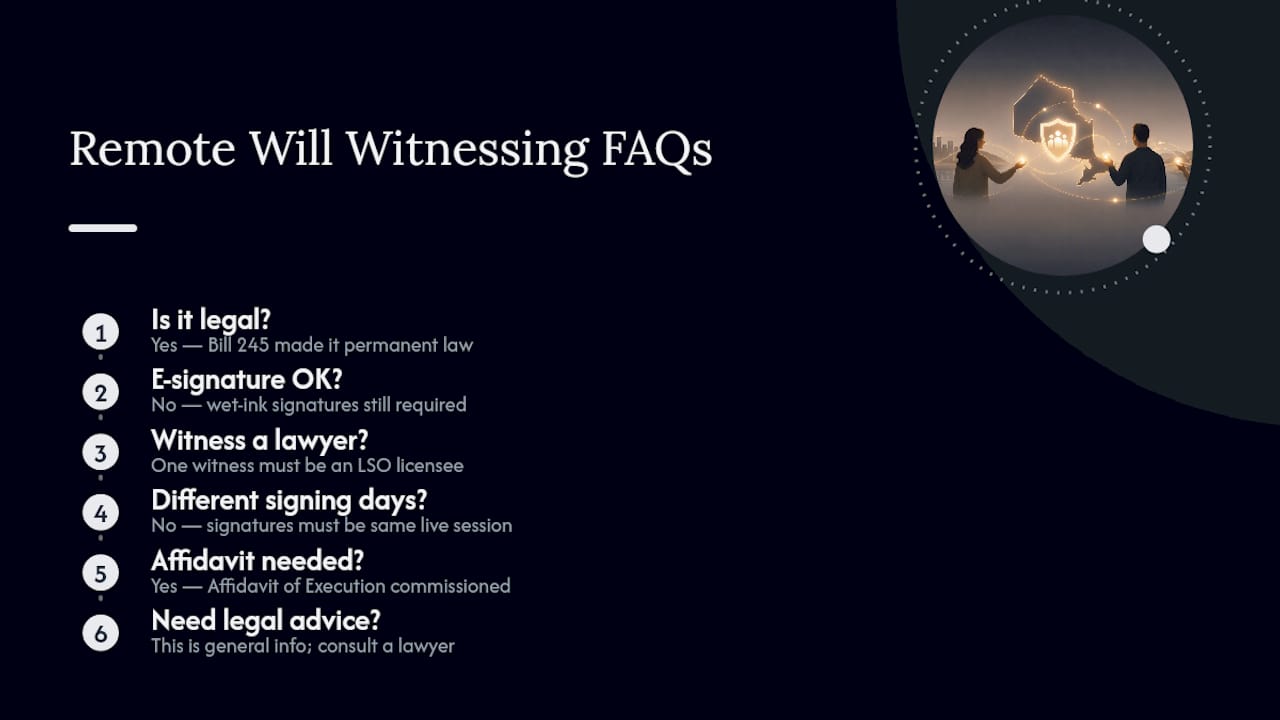
This article is general information, not a substitute for advice from a qualified lawyer. Consult a qualified legal professional about your own circumstances before acting on anything here.
Sources
- Bill 245 — Accelerating Access to Justice Act, 2021 (Ontario Legislative Assembly)
- FAQs about remotely executing wills and powers of attorney (Law Society of Ontario)
- O. Reg. 431/20 — Administering oaths or declarations remotely (Ontario)
- Remote signing and witnessing of wills: what is legally permitted? (Pallett Valo)
- How to properly sign and witness a will in Ontario (Lawyer Info / Canada Lawyer Directory)