A same-name affidavit is a sworn written statement that two versions of a name, such as "Ana Lopez" on a passport and "Anna Marie Lopez" on a degree, belong to one person: you. In Ontario you write it in numbered paragraphs, then swear or affirm it in front of a commissioner of oaths. We commission these by video in about four minutes for $35 CAD, seven days a week from 7 am to 11 pm, and email you the signed PDF.
TL;DR
- A same-name affidavit (also called a name discrepancy affidavit, or an affidavit of one and the same person) declares under oath that different names in your records refer to you.
- The facts must be yours: the names, where each appears, and how the difference came about. Attach copies of the documents as exhibits.
- It has to be signed in front of a commissioner for taking affidavits. You can do that by video call, and the document stays unsigned until the appointment.
- Our price is $35 CAD per affidavit, $20 for each additional document or exhibit and $14.95 for each extra signer.
- The organization that asked for the affidavit decides what else it needs, so check its wording before you draft.
Table of Contents
- What a same-name affidavit is
- When you will be asked for one
- Affidavit or legal name change?
- What to put in your affidavit
- How to get it sworn, step by step
- What it costs
- Notary public or commissioner: which do you need?
- Mistakes that get affidavits sent back
- Our view
- Book your affidavit appointment
- FAQ
- Sources
What a same-name affidavit is
An affidavit is a written statement of facts that you swear or affirm to be true. Swearing uses a religious oath, affirming is the non-religious equivalent, and both carry the same legal weight. A same-name affidavit applies that format to one narrow job: tying together names that do not match across your documents.
Typical mismatches look like this:
- A missing or extra middle name on a diploma or transcript.
- A spelling difference between a birth certificate and a passport.
- A maiden name on older records and a married name on newer ones.
- A name transliterated differently from another alphabet.
- A single-name record on a foreign document and a first-and-last name in Canada.
The statement does not create a new name. It records, under oath, that the names are all yours and explains why they differ. That explanation is what the reader of the document (an officer, an admissions office, a lender) is looking for.
When you will be asked for one
No single federal or provincial rule says "you must file a same-name affidavit." Instead, the organization handling your file asks for one when your documents disagree. Some examples of where the idea comes from:
- Passports. Under the Canadian Passport Order, an applicant who applies in a name other than their legal name, or different from the name on their birth certificate, citizenship certificate or another required document, may be required to submit additional documents or affidavits in clarification.
- Ontario name change. The province's adult name-change application (form 11155E) tells applicants with discrepancies in name, date or place of birth that they will be asked for additional consistent proof and a detailed explanation of where, when and how the information changed, and which documents were used.
- Students and parents. Financial aid files, school registrations and travel paperwork sometimes need a short sworn explanation when a name on one record does not match another. OSAP applicants, for example, are often asked to swear affidavits, and we commission OSAP affidavits at the same $35 CAD.
The request usually comes as a line in an email or checklist. Keep that wording: it tells you what the affidavit should cover.
Affidavit or legal name change?
These solve different problems, and mixing them up wastes time.
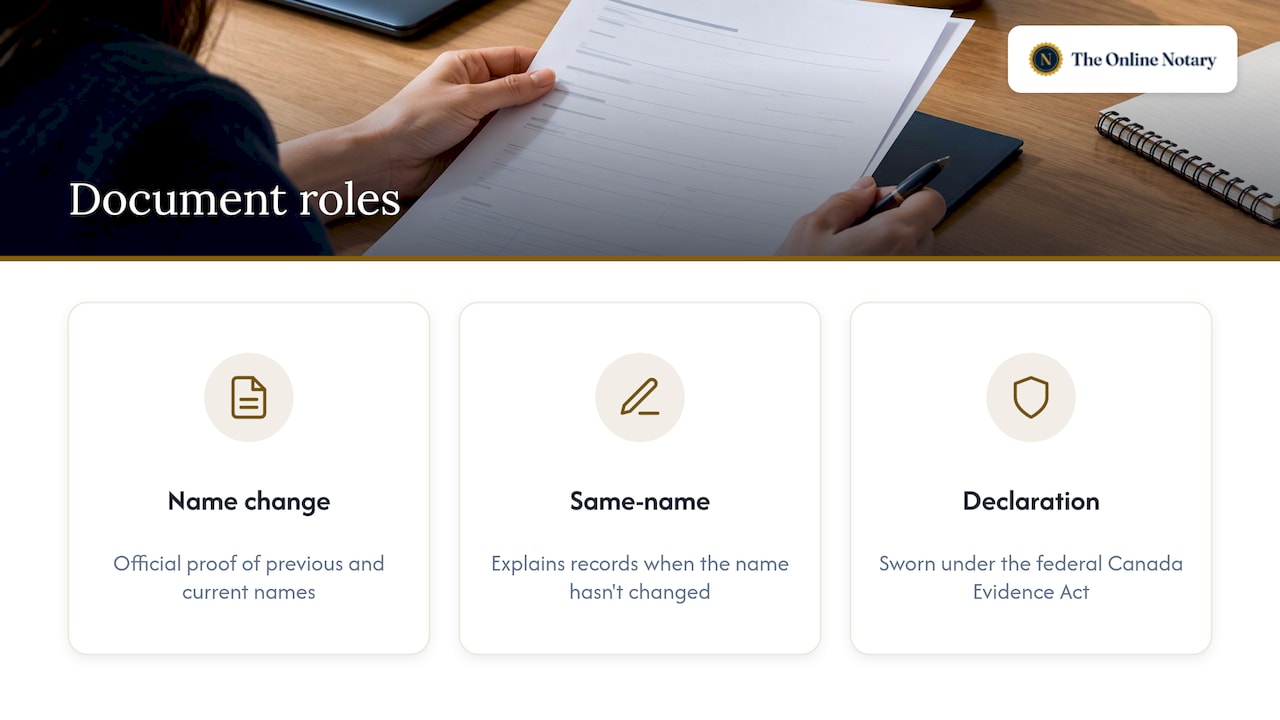
A legal change of name is an official act. IRCC says name-change documents must be issued by a Canadian province or territory, or an appropriate foreign authority, and show your previous and current names. It lists legal change-of-name documents, court orders, adoption orders and certain marriage, divorce or civil-union records. If you have really changed your name, that paper is the proof.
A same-name affidavit explains a difference between records when the underlying name has not changed, or when the change is already documented and one record simply did not catch up. When a name change did happen, the affidavit supports the official document by telling the story in your own words. For passports, Canada.ca explains that after a legal name change, adoption or court decision, you submit your proof of citizenship in the old name, ID showing the new name, and the document showing both names.
A statutory declaration is a close cousin: also a sworn statement, but made under the federal Canada Evidence Act rather than for a court file. Many organizations accept either for a name explanation. Ask which one they want, and we commission both at $35 CAD.
What to put in your affidavit
The Ontario court rules give the standard shape. Rule 4.06 of the Rules of Civil Procedure calls for an affidavit in the first person, stating the deponent's full name (the deponent is the person making the statement), divided into consecutively numbered paragraphs that each cover a particular fact, signed by the deponent, and confined to facts within their personal knowledge. Any alteration must be initialled by the person taking the affidavit. You are not in court, but this layout is the one commissioners and receiving offices recognize, so we suggest following it.
A clear name-discrepancy affidavit usually has these paragraphs:
- Who you are. Your full legal name, city and province of residence.
- The names in question. Each variation, exactly as written on each document.
- Where each appears. The document, issuer, date and number if there is one (for example, a passport issued in one spelling and a diploma in another).
- How the difference arose. A missing middle name, a clerical error, a marriage, a transliteration. Say where, when and how, the same elements the province asks for on its name-change form.
- The declaration. That all the names refer to you, that you are the same person on every listed document.
- The purpose. Who the affidavit is for, such as an immigration file, a school or a lender.
Then add the closing jurat, the block at the bottom where the commissioner records that the statement was sworn or affirmed. For affidavits sworn by video conference, Ontario's court Form 4D provides a jurat option that records both your location and the commissioner's location and refers to O. Reg. 431/20. Our affidavit outline shows the layout if you want to see the structure before you draft.
Keep it short and factual
State only what you know firsthand. Do not guess at why a clerk spelled something wrong; say what the document shows and what you did to correct it, if anything. The Ontario name-change form also warns that making a false statement is an offence, so accuracy matters more than polish.
Exhibits: your supporting documents
An exhibit is a document you attach to the affidavit and refer to by letter, for instance "Exhibit A is a copy of my passport." Good exhibits for a name discrepancy include the ID or certificate in each version of the name, and any record showing the change, such as a marriage certificate.
If an exhibit is not in English or French, the Ontario name-change form asks for a complete photocopy of the original, a complete photocopy of the translation, and a translator's declaration confirming it is complete and correct. A professional translator's declaration need not be sworn. A non-professional translator's declaration must be sworn in front of a commissioner for taking affidavits. Other organizations set their own rules, so check theirs.
How to get it sworn, step by step
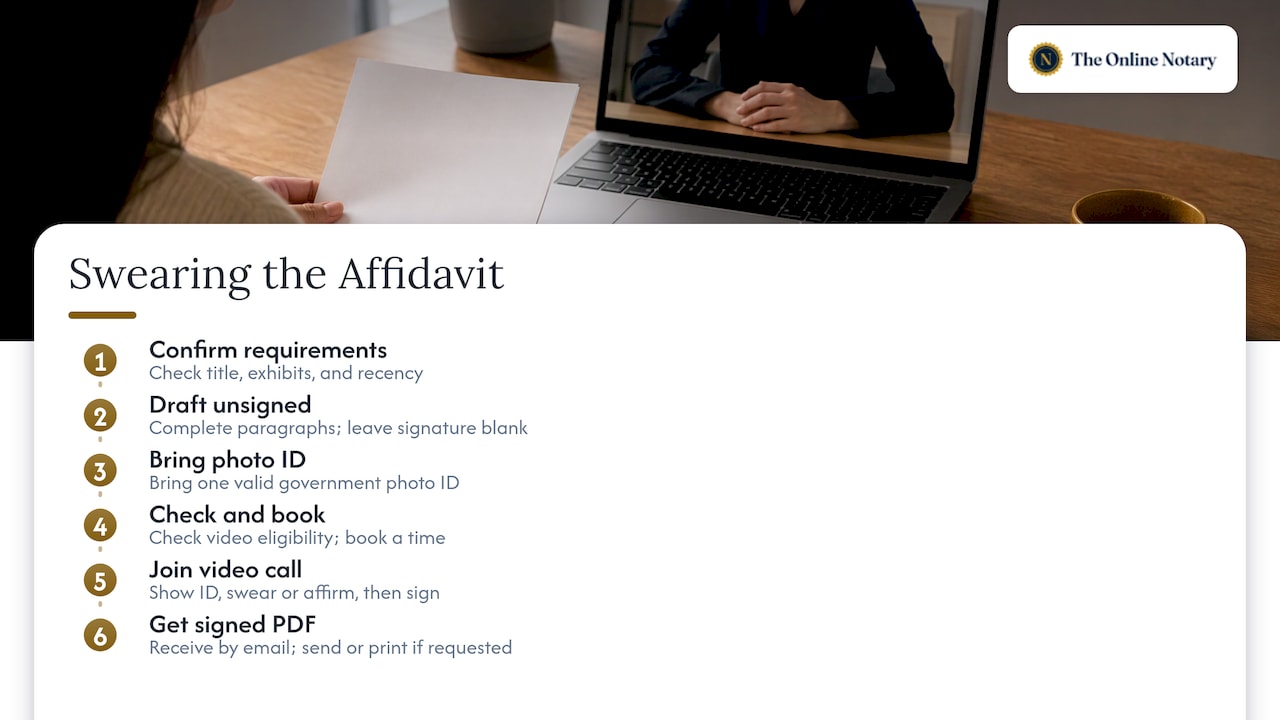
1. Confirm what the receiving organization wants. Look for the exact title ("affidavit of one and the same person," "name discrepancy affidavit," "statutory declaration"), whether it needs exhibits and whether it must be recent. We commission the affidavit you bring; the content comes from your facts and their instructions.
2. Draft it, and leave the signature blank. Complete every paragraph, but do not sign. The signature belongs in front of the commissioner. A municipal commissioner's page, such as the Municipality of West Grey's, gives the same instruction: finish the document, leave the affidavit section unsigned and sign in the commissioner's presence. Signing early is the most common mistake we can head off, and it means redoing the document.
3. Gather one piece of valid government photo ID. The commissioner must confirm who you are. West Grey's page asks for one original government-issued photo ID showing your name and signature. See our guide on what ID you need for a notary before your appointment.
4. Check eligibility and book. Use our eligibility check to see whether your document can be commissioned by video. Then choose a time. Appointments run every day from 7 am to 11 pm.
5. Join the video call. Show your ID, confirm your identity, and the commissioner watches you swear or affirm the contents and sign. The call itself takes about four minutes. Not sure online sessions are valid? Our guide explains whether online notarization is legal in Ontario.
6. Receive your signed PDF by email. Often this arrives right after the appointment. Send it to the organization that requested it, or print it if they ask for paper.
What it costs
Our price for an affidavit or statutory declaration is $35 CAD. The same price covers travel consent letters, OSAP affidavits, affidavits of identity and the other documents listed on our documents page. Fees on the pricing page add up in a predictable way:
| Item | Fee |
|---|---|
| Affidavit or statutory declaration (one signer) | $35 CAD |
| Each additional document or exhibit | $20 CAD |
| Each extra signer | $14.95 CAD |
Worked example: a student whose transcript shows a different spelling from her passport swears one affidavit and attaches copies of both documents as exhibits. If the exhibits are counted as additional documents, that is $35 plus two at $20, or $75 CAD. A couple who each need the same statement sworn would add $14.95 for the second signer. For a wider picture of what Ontario commissioners charge, see our notary cost guide.
Notary public or commissioner: which do you need?
A commissioner of oaths can take affidavits and statutory declarations. A notary public can do that and also certify copies and sign documents that specifically call for a notary. Under the Commissioners for Taking Affidavits Act, as West Grey's page notes, commissioners cannot commission documents requiring a notary public's signature, and a commissioner may refuse any document. A same-name affidavit is a standard commissioning job. If a receiving office asks for a "notarized" copy of a passport or diploma, that is a different service: certified true copies are done at an in-person appointment with us. Our short guide covers notary public versus commissioner of oaths.
If the document is going to another country and needs an apostille, a certificate that authenticates it for foreign use, that step is handled separately; our apostille guide explains where it fits.
Mistakes that get affidavits sent back
- Names typed differently from the documents. Copy each name character for character, including accents and hyphens.
- Pre-signing. Sign only during the call.
- Statements beyond your knowledge. Say what you know and what the record shows.
- Unlabelled exhibits. Mark each one (A, B, C) and reference it in the text.
- Handwritten changes. The court rules require the person taking the affidavit to initial any alteration. It is simpler to reprint.
- Wrong document type. If the receiving office wants a legal name-change certificate, an affidavit alone will not substitute for it.
Our view
Most people who book a name affidavit with us are not in a legal dispute. They are a parent with a travel deadline, a student waiting on funding, or someone whose degree spells their name one way and their passport another. They want a clean document and a short appointment.
What makes the difference is the draft. A short, numbered affidavit with every name written exactly as it appears, and each document attached as an exhibit, is easy for an officer to read and easy for us to commission. We oversee every appointment as an Ontario-licensed paralegal, and we keep hours from early morning to late evening because these deadlines rarely fall at convenient times.
Bring the draft unsigned, bring one valid photo ID, and the video call takes about four minutes.
Ken
Book your affidavit appointment
If your affidavit is drafted, we can commission it by video, with the signed PDF emailed to you. Pick a time on our documents page and book. The fee is $35 CAD for one signer.

If you are in Toronto, Ottawa, Oshawa or Ajax, our Toronto and Ottawa pages show how the same appointment works where you live. Anywhere in Ontario, you can start from our home page.
FAQ
Is a same-name affidavit the same as a name discrepancy affidavit?
Yes, in practice. "Same-name affidavit," "name discrepancy affidavit" and "affidavit of one and the same person" all describe a sworn statement that different names on your records refer to you. Use the title the requesting organization uses, and write the contents to match what they asked for.
Can I swear a name affidavit by video call in Ontario?
Yes. Ontario's court Form 4D includes a jurat for affidavits sworn by video conference, and we commission eligible affidavits this way. You need your unsigned document and a valid government photo ID. Our eligibility check confirms your document qualifies before you book.
What do I attach to my affidavit?
Attach copies of each document showing a version of your name, and any record that explains the change, such as a marriage certificate or a name-change certificate. Mark them as exhibits and refer to them in the text. Each additional document or exhibit is $20 CAD with us.
How long does it take?
The appointment takes about four minutes once your document is ready. We usually email the signed PDF right after the call.
Does the affidavit replace a legal name change?
No. A legal name change is an official record issued by a province, territory or appropriate foreign authority. The affidavit explains and supports your records, and the organization you are dealing with sets what it needs to see.
Sources
- Canadian Passport Order (SI/81-86), Justice Laws Website
- Application to change an adult's name (form 11155E), Ontario
- Canadian citizenship for adults: forms and documents, IRCC
- Applying for a passport, Canada.ca
- Rules of Civil Procedure, RRO 1990, Reg 194, CanLII
- Ontario court Form 4D, affidavit jurat
- Commissioner of Oaths, Municipality of West Grey