

A solemn declaration in Ontario is a written statement of fact that becomes legally binding once you swear or affirm it in front of an authorized officer, such as a notary public or commissioner for taking affidavits. The single requirement most people get wrong: you cannot sign it beforehand. Bring government photo ID, leave the signature line blank, and use the prescribed statutory wording.
TL;DR:
- Only authorized officers such as notaries public and judges can witness your solemn declaration, and they may require an official stamp or seal depending on their role.
- The declaration must be sworn in front of the officer; signing beforehand is a common reason for rejection and delays.
- Remote commissioning is permitted through live video calls if both parties can see and hear each other, but organizations may still require in-person notarization for international use.
- The prescribed wording must be used exactly as outlined in the Canada Evidence Act and Ontario Evidence Act, with facts written as clear, checkable statements.
- Distinguishing between a solemn declaration and an affidavit is essential since affidavits are for court use and must follow stricter formatting rules, while declarations serve administrative purposes.
Table of Contents
- Solemn Declaration Requirements in Ontario: The Legal Basis
- Who Can Commission a Solemn Declaration in Ontario
- The Exact Wording You Need to Use
- Preparing for Your Appointment: Documents, Drafting, and Mistakes to Avoid
- Remote Commissioning: What's Allowed and What Still Trips People Up
- Statutory Declaration or Affidavit: How to Tell Which One You Need
- When a Declaration Isn't Enough: Common Uses and Red Flags
- What Actually Happens at a Commissioning Appointment
- A Notary's View on Why Declarations Get Rejected
- Get Your Solemn Declaration Commissioned Without the Guesswork
- Where to Verify the Rules Yourself
- Sources
Solemn Declaration Requirements in Ontario: The Legal Basis
A solemn declaration draws its authority from two overlapping statutes. Section 41 of the Canada Evidence Act sets out the prescribed wording and names the officers permitted to receive one, while the Ontario Evidence Act mirrors that language for provincial purposes.
Organizations accept declarations for administrative matters, things like replacing a lost title document or confirming a name change, because a declaration carries the same legal weight as a court oath without requiring a courtroom. That weight comes with teeth: knowingly declaring something false can expose you to criminal liability, and officers who sign a jurat without properly administering the declaration risk their own penalties. The document only works because both sides take it seriously.
Who Can Commission a Solemn Declaration in Ontario
Not just anyone can witness your signature and stamp the document. O. Reg. 386/12 and the underlying statutes define who qualifies:
- Notaries public
- Commissioners for taking affidavits
- Lawyers licensed in Ontario (who typically hold commissioner status automatically)
- Judges and justices of the peace
- Certain public officers who hold commissioner status by virtue of their job title
The practical differences matter more than they seem. A ministry-appointed commissioner generally must affix an approved stamp to documents signed in person, while officers who hold the role automatically through their job aren't always required to use one. A missing stamp isn't necessarily a red flag. Notaries public, meanwhile, can also authenticate documents for use outside Canada, which a standard commissioner typically cannot do. If you're unsure whether the person in front of you has authority, ask to see their stamp or Notice of Approval before you start reading through your declaration wording.
The Exact Wording You Need to Use
The statutory language isn't optional phrasing you can paraphrase. The Canada Evidence Act prescribes it word for word, and Ontario's version tracks it closely:
That line sits directly above the jurat, the block where the officer records the date, location, and their own signature and stamp. Everything above it should read as a clean, factual statement. A workable structure looks like this:
- Your full legal name and address
- A numbered list of the specific facts you're declaring
- The date and place of signing (left blank until the appointment)
- The prescribed declaration language above the jurat
Keep the facts concrete. If you want a starting point, our solemn declaration sample walks through a filled-in example line by line.
Preparing for Your Appointment: Documents, Drafting, and Mistakes to Avoid
Show up with the right identification and the document is done in minutes. Show up without it, and you're rebooking.
Bring one piece of current, government-issued photo ID: a passport, an Ontario driver's licence, an Ontario Photo Card, or a permanent resident card. Originals only. Also bring any documents your declaration refers to (a lease, a lost certificate, a bank letter) since the officer may need to see what you're describing.
Two rules matter more than the rest:
- Do not sign the declaration before your appointment. The officer has to witness the signature, not just verify it afterward.
- Write your facts in short, numbered paragraphs. One fact per paragraph, dates and locations included, opinions and hearsay left out.
The most common rejection reasons: using outdated wording, missing jurat details, or filling out a declaration when the receiving organization actually asked for an affidavit.
Pro Tip: Draft your facts as if you were reading them out loud to a stranger who knows nothing about your situation. If a sentence needs "I think" or "I believe" to make sense, rewrite it as something you can state as fact, or leave it out.
Remote Commissioning: What's Allowed and What Still Trips People Up
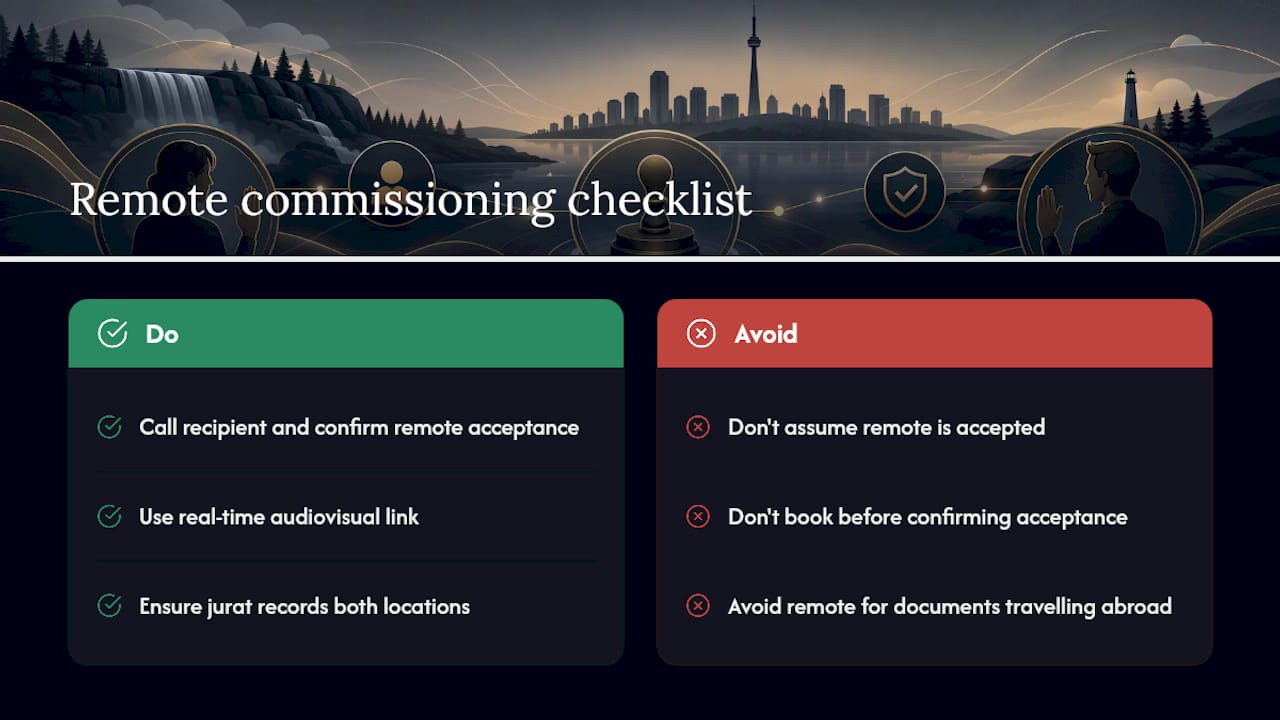
O. Reg. 431/20 permits commissioning by real-time audiovisual link, provided the officer and signer can see and hear each other live, the jurat is modified to record both locations, and the officer keeps proper records of the session. That's the legal side settled.
The practical side is messier. Some banks, foreign registries, and government departments still insist on an in-person appointment, particularly when the document needs to travel outside Canada. A notary public's authentication often carries more weight abroad than a remotely commissioned declaration, since not every foreign authority recognizes Ontario's virtual commissioning framework yet.
Before you book anything, call the organization asking for the document and confirm they'll accept a remote appointment. If you complete a remote commissioning through a statutory declaration completed online only to find the receiver wants an in-person notarization, you've paid for a document you can't use.
Statutory Declaration or Affidavit: How to Tell Which One You Need
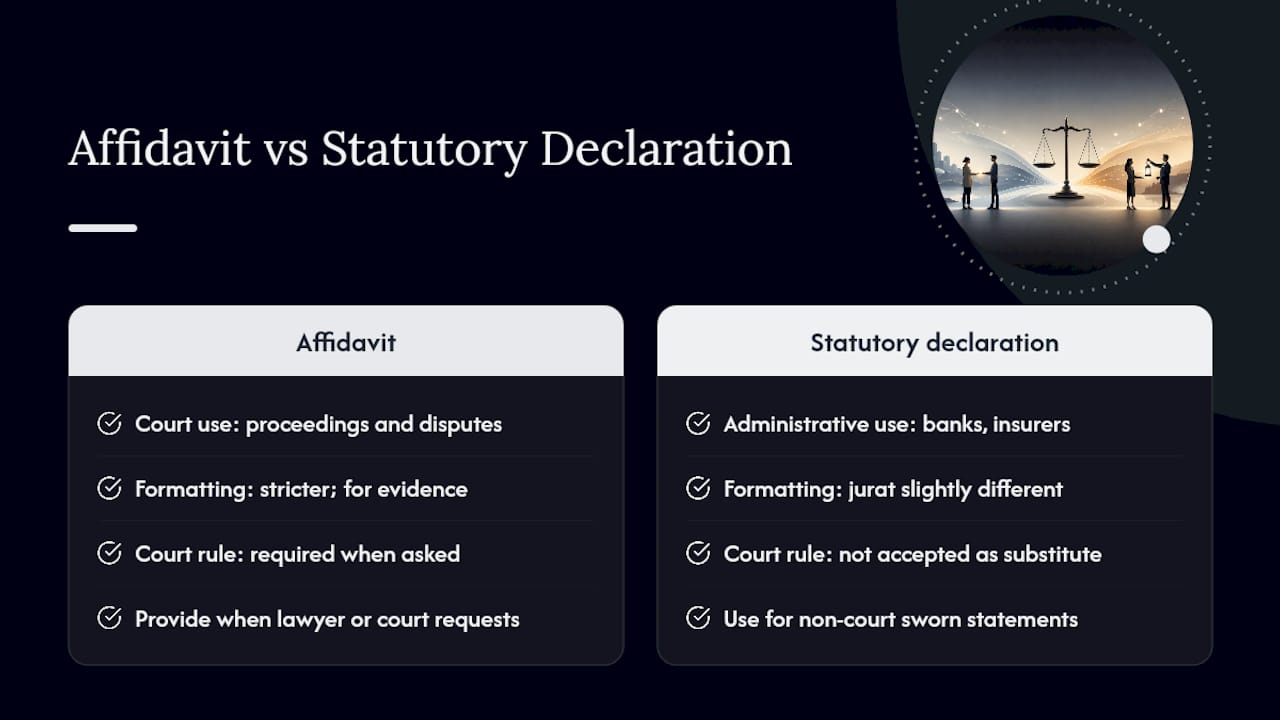
The two documents look similar and often get confused, but the contexts differ. Affidavits are built for court proceedings and legal disputes; they follow stricter formatting rules because a judge may rely on them as evidence. Statutory declarations handle administrative situations: banks, insurers, government registries, and employers that need a sworn statement but aren't running a court case.
The jurat wording differs slightly between the two, and courts generally won't accept a statutory declaration in place of an affidavit. If a lawyer, court clerk, or institution specifically asks for an affidavit, provide an affidavit. Don't assume a declaration will pass as a substitute just because both documents involve swearing to the truth of a statement.
When a Declaration Isn't Enough: Common Uses and Red Flags
Solemn declarations show up most often in situations like replacing a lost passport or vehicle title, confirming a change of name or address, supporting an insurance claim, filing corporate paperwork, or backing up an immigration application with a statement of fact.
Certain situations tend to push receivers toward demanding something stronger:
- Any document heading into a court file usually needs an affidavit, not a declaration.
- Foreign land registries or government agencies often require full notarization rather than a domestic commissioner's stamp.
- Mortgage lenders and title insurers sometimes have their own internal standards that exceed the statutory minimum.
The fastest way to avoid wasted effort: ask the receiving organization exactly what form they need before you draft anything, rather than guessing based on what worked for someone else's situation.
What Actually Happens at a Commissioning Appointment
The appointment itself is short, but skipping a step means starting over.
- Before the appointment: Confirm the receiving organization accepts the document as drafted. Prepare the declaration with the signature line left blank, and gather your ID and any supporting documents.
- At the appointment: Present your photo ID to the officer. They may ask you to read the declaration aloud or confirm you understand its contents. Sign only once the officer is watching. The officer then completes the jurat, adds the date and location, and applies their stamp or seal.
- After the appointment: Keep the commissioned original in a safe place; most organizations want the original, not a photocopy. If the document is headed outside Canada, ask whether it needs additional authentication or legalization before it travels.
That sequence rarely takes more than 15 minutes once your paperwork is ready, whether you're sitting across a desk or connecting through a remote notary appointment.
A Notary's View on Why Declarations Get Rejected
Most rejected declarations don't fail because of the law. They fail because of vague drafting. Phrases like "to the best of my knowledge" or unsupported opinions weaken a document that's supposed to read as plain fact. Rewrite each paragraph as a single, checkable statement, and rejections drop sharply.
Choosing between a notary and a commissioner comes down to destination. If the document stays in Ontario for a bank, employer, or provincial registry, a commissioner for taking affidavits is usually sufficient and faster to book. If it's heading to another country, or into a foreign court or land registry, a notary public's authentication carries more recognition and saves a second trip later.
— Ken
Get Your Solemn Declaration Commissioned Without the Guesswork
Remote commissioning for solemn and statutory declarations can be done without requiring you to drive anywhere or sit in a waiting room for a stamp. Through a live video call, an authorized commissioner or notary may review your document and ID under the conditions set out in O. Reg. 431/20, enabling you to receive a properly executed declaration potentially the same day.

Before booking, confirm with the organization requesting your document that a remotely commissioned declaration meets their requirements. If they do, book a notary appointment and get your document reviewed and commissioned in one sitting, rather than juggling wording questions and appointment logistics on your own.
Where to Verify the Rules Yourself
- Canada Evidence Act, Section 41: the prescribed declaration wording and officer list.
- Ontario Evidence Act: the provincial version of that wording.
- O. Reg. 431/20 remote commissioning guidance (Form 4D): remote rules and jurat templates.
- O. Reg. 386/12: the list of who qualifies as a commissioner.
- Guide for newly appointed commissioners: officer duties and ID verification steps.
Sources
- Canada Evidence Act — Section 41 (Solemn declaration)
- Evidence Act, R.S.O. 1990, c. E.23 — Solemn declaration
- Court form and remote jurat guidance — Form 4D (Ontario court forms)
- Guide for newly appointed commissioners for taking affidavits in Ontario