

A statutory declaration in Ontario is a written statement you solemnly declare to be true before an authorized official, and it must include the exact solemn declaration wording set out in the Ontario Evidence Act. Never sign it before your appointment. The commissioner or notary needs to watch you sign, whether in person or over live video, or the document is invalid and you'll be redoing the whole thing.
TL;DR:
- Failing to sign the declaration only during the appointment invalidates the document, making early signing the most common mistake to avoid.
- The declaration must end with the exact solemn clause stating it has the same legal effect as an oath, or it risks rejection and losing legal weight.
- Online notary services can handle remote declarations, but confirming acceptance by the receiving institution beforehand is crucial because legal validity does not guarantee acceptance.
- Signatures must be witnessed by an authorized official, such as a lawyer, commissioner, or notary, who must observe your signing and properly complete the jurat.
- Two pieces of government-issued ID with matching names are necessary; discrepancies like maiden names or address mismatches can delay or invalidate the appointment.
Table of Contents
- Understanding Statutory Declaration Requirements in Ontario
- The Required Wording, Form Fields, and Jurat
- Who Can Witness a Statutory Declaration in Ontario
- How to Prepare and Sign, Including Remote Commissioning Rules
- Statutory Declaration vs Affidavit: Which One Do You Need
- Common Uses, Top Mistakes, and Legal Risks
- Why Ontario Residents Trust Online Notaries for This
- An Editorial Take on Getting This Right the First Time
- Book Your Statutory Declaration With an Online Notary Service
- Sources
- FAQ
Understanding Statutory Declaration Requirements in Ontario
A statutory declaration is a written statement a person swears is true, made in front of a commissioner for taking affidavits, a notary public, or another official authorized under Ontario law. It carries the same legal weight as testimony given under oath, which is exactly why the wording matters so much.
Section 43 of the Ontario Evidence Act requires the declaration to close with a specific solemn clause, and receiving agencies check for it. Institutions rarely accept a document that's missing this language or paraphrases it, because the clause is what gives the statement its legal force under the Canada Evidence Act as well.
Agencies and institutions that commonly request statutory declarations include:
- Insurance companies processing claims where sworn proof is needed
- Banks and financial institutions verifying identity or account details
- Government departments handling immigration, name changes, or lost document replacement
- Employers or licensing bodies requiring a declaration of facts not easily proven otherwise
The Required Wording, Form Fields, and Jurat
The statute isn't flexible on this point. Section 43 of the Ontario Evidence Act requires the declaration to end with: "I make this solemn declaration conscientiously believing it to be true and knowing that it is of the same force and effect as if made under oath." Swap out a word or drop the phrase entirely and you risk having the whole document bounced back by whoever asked for it.
Beyond the clause itself, a properly drafted statutory declaration needs:
- Your full legal name, current address, and occupation
- Numbered paragraphs stating each fact you're declaring, written in plain, factual language
- A clear statement of the purpose (why you're making this declaration)
- Space for the jurat, the block where the commissioner records the date, location, and their signature
Pro Tip: If your facts run long, attach a separate schedule and initial every page, including the schedule pages, at your signing appointment, not before. The commissioner initials them too.
One detail catches people off guard: the Commissioners for Taking Affidavits Act actually penalizes the official, not just the signer, for cutting corners. A commissioner who signs a jurat without properly administering the declaration faces a monetary fine as set out by law under section 10. That's a strong incentive for any legitimate commissioner to insist on doing this by the book, including refusing to accept a document you've already signed.
Who Can Witness a Statutory Declaration in Ontario
Ontario has several categories of people authorized to take statutory declarations, and knowing which one you need can save you a wasted trip.
- Lawyers and paralegals, who are commissioners by virtue of their office and typically don't need to stamp the document
- Appointed commissioners for taking affidavits, often working in government offices, banks, or law firms, who generally must use an official stamp
- Notaries public, who hold all the powers of a commissioner plus the ability to certify true copies and authenticate documents
The distinction between a commissioner and a notary matters most when your document is headed outside Canada. Notaries carry additional authority to certify and authenticate documents in ways a standard commissioner cannot, which becomes essential if the receiving country or institution requires further authentication.
Whoever you choose, bring acceptable government-issued photo ID, a driver's license, passport, or provincial ID card. The name on that ID has to match the name on your declaration exactly. A maiden name, a missing middle initial, or an old address can stall the whole appointment.
Pro Tip: Don't assume a missing stamp means a document is defective. A lawyer acting as a commissioner by virtue of office often signs without one, and that's still perfectly valid.
How to Prepare and Sign, Including Remote Commissioning Rules
Getting this right on the first try comes down to sequence. Follow these steps in order:
- Draft your facts first. Write out each numbered statement clearly and factually, without emotional language or legal conclusions you're not qualified to make.
- Leave the signature line blank. Do not sign or date anything before your appointment. A commissioner cannot accept a pre-signed document, and signing early invalidates it entirely.
- Gather two pieces of ID, at least one with a photo, and make sure the name matches what's on the declaration.
- Confirm the recipient's exact form requirements before booking, since some agencies have their own templates and may reject a generic one.
- Check whether remote commissioning is acceptable to the receiving party. Not every institution accepts a digitally signed declaration, even when the process is legally valid.
- Sign only when instructed, during the live session, whether that's in person or over video.
Remote commissioning became legally possible in Ontario under O. Reg. 431/20, which permits an official to administer a declaration over live audio-visual technology. The regulation sets four firm conditions: continuous live video and audio contact throughout, verification of your identity on camera, a modified jurat that records both your location and the commissioner's location, and a record-keeping obligation on the commissioner's part.
Pro Tip: Legal validity and practical acceptance aren't the same thing. A remotely commissioned declaration meets every requirement of the regulation, but some receiving institutions still insist on an in-person version, so confirm before you book.
Once you've signed, the commissioner completes the jurat, applies their stamp if required, and initials any attached pages alongside you.
Statutory Declaration vs Affidavit: Which One Do You Need
The two documents look similar on paper but serve different legal functions, and using the wrong one is one of the fastest ways to get a filing rejected.
- An affidavit involves swearing or affirming an oath and is the standard format for court proceedings and formal litigation.
- A statutory declaration uses the solemn declaration clause instead of an oath and is generally used for administrative, non-court purposes, like insurance claims or government forms.
- Courts and tribunals almost always require an affidavit; if you're filing in a legal proceeding, a statutory declaration usually won't be accepted as a substitute.
- Administrative bodies, banks, and most government departments are typically satisfied with a statutory declaration, since the legal effect under the Canada Evidence Act is comparable for their purposes.
If you're unsure which applies to your situation, our breakdown of the difference between affidavits and statutory declarations walks through specific scenarios in more detail. As a rule of thumb: court filing means affidavit, administrative proof usually means statutory declaration.
Common Uses, Top Mistakes, and Legal Risks
Statutory declarations show up most often for lost or damaged documents, correcting a name discrepancy, supporting an insurance claim, business filings, and immigration paperwork, where IRCC materials frequently reference them directly.
The mistakes that cause rejections are almost always the same five:
- Signing or dating the document before the appointment
- Using an affidavit format when a declaration was required, or vice versa
- Leaving out the statutory solemn clause or altering its wording
- Bringing insufficient or mismatched ID
- Forgetting to initial attached schedules or extra pages
The stakes go beyond a rejected form. A false statutory declaration is treated the same as false testimony under oath, and knowingly making one can expose you to criminal charges under the Criminal Code. This isn't paperwork you want to rush.
Why Ontario Residents Trust Online Notaries for This
This guide draws on Ontario's actual statutes rather than generic templates, written and maintained by Ken, whose linked breakdowns on affidavits, notarization, and remote commissioning reflect a working familiarity with how these rules apply in practice. Some providers offer both online commissioning for Ontario residents who qualify for remote sessions and in-person notary services for certified true copies and document notarization, so readers have a path forward whether their situation calls for a video appointment or a signature in front of someone in the same room.
An Editorial Take on Getting This Right the First Time
Most advice on statutory declarations treats the wording requirement as a formality, a box to check before moving on to the "real" work of gathering ID and booking an appointment. That's backwards. The solemn clause in section 43 isn't decoration. It's the entire legal mechanism that gives your declaration the same weight as sworn testimony, and receiving agencies know it. Get that clause wrong, and everything else you did correctly is irrelevant.
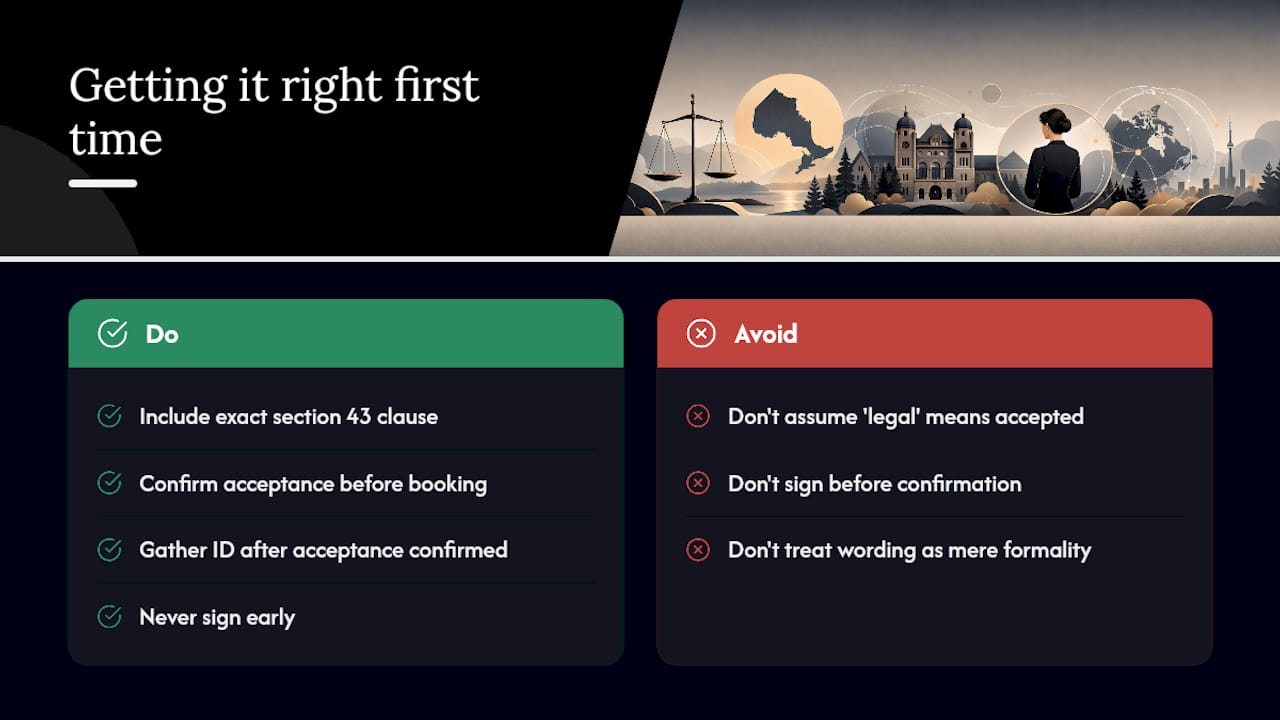
The bigger gap I see is around remote commissioning. O. Reg. 431/20 made it legal, and people treat "legal" as the same thing as "accepted." It isn't. A bank or a foreign consulate can meet every requirement of the regulation and still tell you no, because acceptance is their call, not the province's. If your document needs to survive contact with a picky institution, confirm acceptance before you book anything, not after.
If you take one thing from this: never sign early. It's the single most avoidable mistake, and it invalidates everything.
— Ken
Book Your Statutory Declaration With an Online Notary Service
If you'd rather skip the guesswork on wording, jurats, and remote-commissioning rules, some online notary services handle the entire process, matching the exact statutory language Ontario requires and confirming upfront whether a remote session will work for your situation. That's the real advantage over drafting a declaration yourself and hoping an agency accepts it: you get a commissioner who already knows what recipients look for.

Theonlinenotary's online notary services cover statutory declarations, affidavits, invitation letters, and remote witnessing for wills and powers of attorney, all completed over a live video appointment that satisfies O. Reg. 431/20. For anyone who still needs a document handled in person, in-person notarization is also available in Brampton. Book an appointment through the services page and get your document signed correctly the first time.
This article is general information, not a substitute for advice from a qualified lawyer. Consult a qualified legal professional about your own circumstances before acting on anything here.
Sources
FAQ
How do I get a statutory declaration done in Ontario?
Draft your facts, leave the signature blank, gather two pieces of ID with at least one photo ID, and book an appointment with a commissioner, lawyer, or notary, either in person or through a service like Theonlinenotary for remote sessions.
What is the required wording for a statutory declaration?
It must end with the solemn clause from the Ontario Evidence Act: "I make this solemn declaration conscientiously believing it to be true and knowing that it is of the same force and effect as if made under oath."
What exactly is a statutory declaration?
It's a written statement of facts that a person declares to be true in front of an authorized official, carrying the same legal force as testimony given under oath, without requiring a court appearance.
Who can witness a statutory declaration in Canada?
Lawyers and paralegals acting as commissioners by virtue of office, appointed commissioners for taking affidavits, and notaries public can all witness statutory declarations, with notaries offering added authority for documents used outside Canada.