

Under Ontario law, a formal will must be signed by the testator in the physical or authorized virtual presence of two adult witnesses who sign at the same time, unless the will is wholly handwritten. That handwritten version, called a holograph will, skips witnesses entirely because the testator's own handwriting stands in for the safeguard witnesses usually provide.
The rule sounds simple, and mostly it is. The mistakes happen in the details.
- Two witnesses, one moment. Both must watch the testator sign, or watch the testator acknowledge an existing signature, at the same time, whether that's around a kitchen table or on a video call.
- Competence matters. Witnesses must be legal adults and mentally capable of understanding what they're witnessing. Never pick a beneficiary or a beneficiary's spouse.
- Remote signing works, with a catch. Audio-visual witnessing is legal in Ontario, but at least one witness on the call has to be a licensed lawyer or paralegal.
Get any one of these wrong and you're not just risking a technicality. You're risking a court fight over whether the will is valid at all.
Key Takeaways
A valid Ontario will requires two competent, disinterested adult witnesses signing in the testator's contemporaneous presence, unless it qualifies as a holograph will.
| Point | Details |
|---|---|
| Two witnesses, same moment | Both must watch the testator sign and then sign themselves, in person or on an authorized video call. |
| Avoid interested witnesses | Beneficiaries and their spouses can still witness, but doing so voids their own gift under section 12. |
| Holograph wills skip witnesses | A will entirely in the testator's handwriting is valid with no witnesses, but carries higher dispute risk. |
| Remote needs a licensed witness | Audio-visual signing is legal only when at least one witness is a lawyer or paralegal licensed in Ontario. |
| Theonlinenotary handles the details | Offers licensed remote witnesses and same-appointment affidavit support for compliant will signings in Ontario. |
Table of Contents
- Will Witness Requirements Ontario: What the Statute Says
- Who Cannot Witness a Will and What Happens If They Do
- When a Handwritten Will Skips the Witness Requirement
- Remote Will Witnessing in Ontario: The Video Call Rules
- Why an Affidavit of Execution Matters for Probate
- Signing Checklist: In-Person and Remote
- How Theonlinenotary Supports Compliant Will Witnessing
- What Most Guides Get Wrong About Witnessing
- Get Your Will Witnessed Correctly With Theonlinenotary
- Frequently Asked Questions
- Sources
Will Witness Requirements Ontario: What the Statute Says
The rules aren't a matter of custom or convention. They come directly from the Succession Law Reform Act, R.S.O. 1990, c. S.26, and section 4 does the heavy lifting. It requires the testator to sign at the end of the will, in the presence of two or more witnesses, who then sign in the testator's presence too.
That "at the end" detail trips people up more than you'd expect. If you add a clause below your signature, courts may treat that addition as unsigned and therefore invalid, even if the rest of the will is fine. This is exactly why lawyers push clients to finalize the document completely before anyone picks up a pen.
A valid will in Ontario requires the testator's signature at the end of the document, made or acknowledged in the presence of two witnesses who are both present at the same time and who then sign in the testator's presence. No specific attestation clause is mandated by the statute itself.
The Act doesn't demand a particular attestation clause or a specific form of words. That flexibility is useful, but it also means the burden of proof falls on evidence of proper execution if anyone ever challenges the will. This is where a lot of home-signed wills quietly fall apart years later, when the testator isn't around to explain what happened.
A few habits close that gap:
- Initial every page, not just the signature page, so no one can argue a page was swapped after signing.
- Note the date and location of signing directly on the document.
- Keep the witnesses' full names and contact information somewhere accessible, ideally attached to the will itself.
None of this is legally mandatory. All of it is what separates a will that sails through probate from one that gets contested.
Who Cannot Witness a Will and What Happens If They Do
Section 12 of the Act creates a specific trap: if a witness is also named as a beneficiary, or is married to a beneficiary, the gift to that person is void. The will itself usually survives. The gift doesn't.
- Beneficiaries cannot witness their own inheritance. If your daughter witnesses your will and you've left her the house, that gift is presumptively voided, even though her signature as a witness remains valid.
- Spouses of beneficiaries carry the same risk. Marrying into a gift doesn't protect it. If your witness's spouse is named in the will, that gift can be struck the same way.
- Executors and creditors can usually witness. Being named as an executor doesn't disqualify someone from also serving as a witness, and even a creditor of the estate is generally fine unless they're also picking up a bequest.
The safest move is picking witnesses with nothing at stake. A neighbor, a coworker, or bank staff who won't inherit a dime make far better witnesses than family members hovering near the will's contents, because their impartiality removes the most common ground for a challenge.
Pro Tip: If a family member absolutely has to witness because no one else is available, have them sign an acknowledgment confirming they receive nothing under the will. It won't fix a genuine section 12 problem, but it heads off a lot of unnecessary suspicion later.
When a Handwritten Will Skips the Witness Requirement
Section 6 of the Act carves out one real exception to all of this: a will written entirely in the testator's own handwriting and signed by them is valid with zero witnesses. Lawyers call it a holograph will, and it exists for exactly the situations you'd expect: emergencies, isolation, or someone who simply never got around to formal estate planning before it mattered.
The trade-off is real. Without witnesses, there's no one to confirm the testator's mental state at the time of signing, no one to attest the signature is genuine, and no protection against a document that's ambiguous about what it actually intends to do.
- A holograph will must be entirely handwritten. Filling in a printed template by hand doesn't count.
- Typed portions or printed letterhead can void the exemption, since the "wholly handwritten" test is strict.
- Vague wording is far more dangerous here, since there's no attestation record to help a court interpret intent.
Treat a holograph will as a bridge, not a destination. It's the right tool when you need something valid immediately, and the wrong long-term plan once a properly witnessed will becomes possible.
Remote Will Witnessing in Ontario: The Video Call Rules
Ontario made audio-visual witnessing a permanent option through amendments tied to Bill 245, and the Law Society of Ontario has confirmed the practical rule that matters most: at least one witness on the call has to be a licensed lawyer or paralegal. You can't just grab two friends on a video call and call it done.
Ontario Regulation r.20164 fills in the mechanics, including allowing signatures in counterpart. That means the testator and witnesses don't need to sign the exact same physical page. They can each sign identical copies during the same video session, and those copies together form the will.
- Verify identity before signing starts. Have government-issued photo ID visible on camera for the testator and both witnesses.
- Sign in the same session, without gaps. Everyone signs their counterpart copy while the call is active, not before or after.
- Confirm the copies match. Minor formatting differences across counterparts are fine, but the substantive content has to be identical.
- Record the details. Note the date, time, platform used, and who was present, then keep that record with the signed will.
The biggest pitfall isn't technical, it's timing. If a witness signs their copy after the call ends "just to be safe," that undermines the contemporaneous presence requirement the whole framework depends on. Reviewing how to prepare for a virtual notary session before your appointment helps avoid exactly that kind of slip.
Pro Tip: Ask your licensed witness to record the video session, or at minimum keep a timestamped log of the call. Courts have discretion to validate imperfect execution, but that's a costly backstop, not a plan.
Why an Affidavit of Execution Matters for Probate
A will can be perfectly valid without an affidavit of execution. Try to probate it without one, though, and you'll usually hit friction, because the Superior Court of Justice typically wants Form 74.8 as proof that the signing happened the way the law requires.
The form is sworn by one of the witnesses, usually in front of a notary or commissioner of oaths, and it confirms the basics: that the testator signed, that both witnesses were present, and that everything happened the way section 4 demands. Getting it done at the signing appointment, while memories are fresh and everyone's still in the room, saves real time and expense down the road.
- Have one witness swear the affidavit immediately after signing, rather than tracking them down months or years later.
- Keep the sworn affidavit stapled or clipped to the original will, not filed separately.
- Store the original in a location your executor actually knows about, since a perfectly executed will does nothing if no one can find it.
Practitioners consistently flag delayed affidavits as one of the most avoidable causes of probate slowdowns. It's a five-minute step that prevents a months-long scramble to locate witnesses who've moved, lost touch, or simply forgotten the details.
Signing Checklist: In-Person and Remote
In-person signing:
- Confirm both witnesses' identities and ask if either is a beneficiary or married to one.
- Sign your name at the very end of the will, with both witnesses watching.
- Have both witnesses sign immediately after, in your presence and each other's.
- Initial every page of the will, not just the final signature page.
- Have one witness swear Form 74.8 before a notary or commissioner right away.
Remote signing:
- Confirm your licensed witness in advance and schedule a secure video call.
- Verify photo ID for everyone on camera before signing begins.
- Sign identical counterpart copies without leaving the call.
- Log the date, platform, and attendees for your records.
- Arrange for the affidavit of execution to be sworn right after the session ends.
Tell your executor exactly where the original will and its affidavit live. A will locked in a safety deposit box no one can access causes almost as much trouble as no will at all.
How Theonlinenotary Supports Compliant Will Witnessing
Executing a will correctly the first time avoids the exact problems this article has walked through: voided gifts, missing affidavits, and disputes over whether witnesses were really present at the same moment.
- Licensed witness participation on every remote session, satisfying the Law Society's requirement for audio-visual execution.
- Affidavit of execution support arranged as part of the same appointment, not as a separate errand weeks later.
- Secure record-keeping of the signing session, including identity verification and session details.
Ken has spent years working through the procedural side of remote signings in Ontario, the kind of practical detail that a statute never quite spells out: how to sequence a video call, what to check before anyone signs, and what evidence actually holds up if a will gets questioned later.
What Most Guides Get Wrong About Witnessing
Most explainers treat witness requirements as a checkbox: get two adults, get their signatures, done. That's technically accurate and practically incomplete. The real risk isn't failing to find two people willing to sign. It's picking the wrong two people, or getting the sequence of events slightly out of order in ways that only surface after the testator has died and can't fix it.
The 2022 shift letting courts validate improperly executed wills under substantial compliance gets treated by some as a safety net. It isn't one. It's an expensive, uncertain court application that assumes a judge will agree the paperwork reflects genuine intent. Nobody should sign a will banking on that discretion being exercised in their favor.
If I had to prioritize one thing for readers, it's this: get the affidavit of execution sworn the same day as signing, every time, no exceptions. It costs almost nothing in the moment and it's the single most common gap that turns a valid will into a probate delay.
Get Your Will Witnessed Correctly With Theonlinenotary
Hiring an estate lawyer for a full-service signing appointment works, but it's often slower to schedule and costs more than most people expect for what amounts to one signing session. Theonlinenotary gives Ontario residents a faster, fixed-cost way to complete a legally compliant remote will signing, with a licensed witness on every call and affidavit support built into the same appointment.

That combination matters because the two biggest risks in DIY signing, missing the licensed-witness requirement and skipping the affidavit until it's inconvenient, get handled automatically rather than left to chance. Theonlinenotary also supports the paperwork that often surrounds a will signing, including affidavits of execution and statutory declarations for related estate matters.
Ready to book a compliant remote signing session? Visit Theonlinenotary's services page to check availability and get started.
Frequently Asked Questions
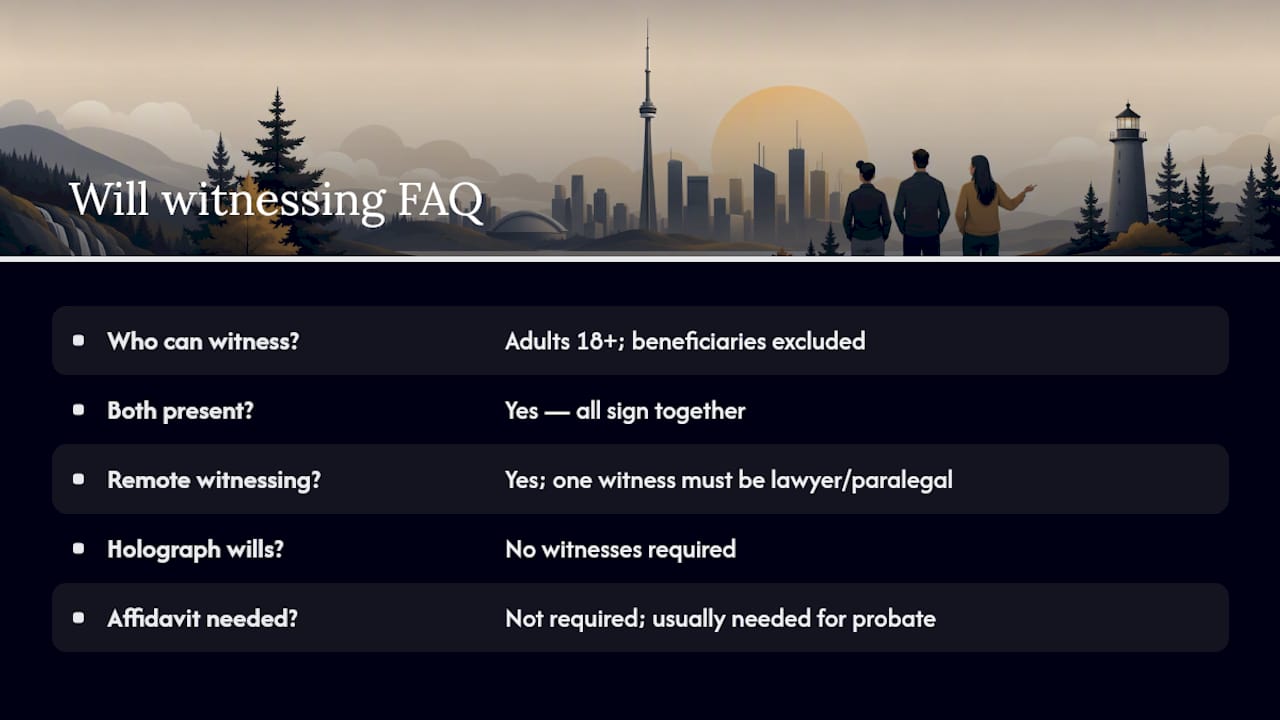
Can any adult witness a will in Ontario? Most adults 18 or older with the mental capacity to understand what they're witnessing can serve as a witness. The exception is anyone named as a beneficiary, or married to one, since witnessing in that case voids their own gift under section 12 of the Succession Law Reform Act.
Do both witnesses need to be present at the same time? Yes. The testator's signature must happen in the contemporaneous presence of both witnesses together, not one after the other. This applies whether the signing happens in person or over an authorized video call.
Is remote will witnessing legal in Ontario? Yes, permanently, as confirmed by the Law Society of Ontario. At least one witness on the call must be a licensed lawyer or paralegal, and everyone signs identical counterpart copies during the same session.
What happens if a will is witnessed incorrectly? The will may be challenged or refused probate. Courts have discretion since 2022 to validate documents that reflect genuine testamentary intent despite execution errors, but that process is uncertain and costly, so proper witnessing from the start is always the safer route.
Does a handwritten will need witnesses in Ontario? No. A holograph will written entirely in the testator's own handwriting and signed by them is valid under section 6 without any witnesses at all.
Why do I need an affidavit of execution if my will is already valid? The affidavit isn't required to make the will legally valid, but the Superior Court of Justice typically requires Form 74.8 as evidence of proper execution before granting probate, so skipping it just delays your estate later.
This article is general information, not a substitute for advice from a qualified lawyer. Consult a qualified legal professional about your own circumstances before acting on anything here.
Sources
- Ontario
- FAQs about remotely executing wills and powers of attorney | Law Society of Ontario
- Holograph wills in Ontario | Pallett Valo