

A beneficiary who witnesses a will in Ontario doesn't invalidate the will, but it does presumptively void their own gift under the Succession Law Reform Act, unless a court is convinced no undue influence occurred. Notaries and commissioners face a parallel rule: acting on a document where they hold a personal or financial interest undermines their impartiality and can taint the entire signing. The fix in both cases is the same. Pick disinterested witnesses, confirm the official's actual appointment, and get an Affidavit of Execution on file.
TL;DR:
- Beneficiaries who witness a will in Ontario lose their gift unless a court finds no undue influence, making proper witness selection essential.
- Witnessing or notarizing a document with a personal or financial interest risks invalidating the entire document or gift and should be avoided.
- Disqualified witnesses include beneficiaries, their spouses, minors, and those lacking mental capacity, so using independent, disinterested witnesses is safest.
- Notaries can certify true copies for international use, but commissioners cannot, so choose the correct official based on your document’s destination.
- Promptly obtaining and maintaining an Affidavit of Execution and witness contact details helps prevent costly disputes if questions arise later.
Table of Contents
- What the Succession Law Reform Act Says About Interested Witnesses
- Who Can Legally Witness a Document in Ontario?
- Notary Public vs. Commissioner: Why the Difference Matters
- How to Prevent Witness or Notary Conflicts Before You Sign
- What Happens If a Conflict Surfaces After the Document Is Signed
- Ken's Take: Why Neutral Witnesses Protect Everyone, Not Just the Signer
- Get Your Documents Notarized Without the Guesswork
- Where These Rules Come From
- Sources
- FAQ
What the Succession Law Reform Act Says About Interested Witnesses
Ontario's Succession Law Reform Act doesn't throw out a will just because a beneficiary signed as a witness. What it does is strip that beneficiary (and their spouse) of the gift left to them, on the theory that a person shouldn't be allowed to witness their own windfall. The rest of the will stays intact.
Two statutory escape hatches exist, and both are narrower than people assume. Section 12(3) lets a court validate the gift anyway if it's satisfied the beneficiary didn't exert improper or undue influence over the signing. Section 21.1, Ontario's "substantial compliance" provision, gives judges room to excuse technical execution errors when other evidence shows the document reflects the testator's genuine, settled wishes.
Recent decisions show this discretion is real but unpredictable. Courts examining these cases focus heavily on intention and the presence or absence of pressure, and outcomes swing on the specific facts in front of the judge, not on a fixed formula. One analysis of beneficiary-witness cases notes that Ontario and Saskatchewan courts have both revived gifts under similar reasoning, but never as a guaranteed outcome.
That uncertainty carries a price tag. Fixing a defective execution after the fact usually means:
- A court application, with legal fees that can run into the thousands
- Delay in administering the estate while the matter is resolved
- An evidentiary burden on the beneficiary to prove no undue influence, which estate practitioners note shifts the burden onto them rather than leaving it neutral
A gift to a witness-beneficiary is presumptively void the moment the ink dries. Court validation is possible, not automatic, and it's never the plan you want to rely on going in.
Who Can Legally Witness a Document in Ontario?
The eligibility bar for witnesses is lower than most people expect, but the disqualifications matter. A valid witness in Ontario must be:
- At least 18 years old
- Mentally capable of understanding what they're witnessing
- Not a beneficiary named in the document, and not the spouse of one
That third condition trips people up constantly, because it disqualifies people who feel like the "obvious" choice, an adult child, a caregiving spouse, a business partner who stands to inherit shares. Standard guidance on will witnesses recommends using two independent, disinterested witnesses and having them sign an Affidavit of Execution at the same sitting, since that affidavit becomes the evidence a probate court relies on if anyone later challenges the signing.
Safe witness choices tend to be neighbors, coworkers, or staff at a law or notary office who have no stake in the document's outcome. Family members and even paid "professional witness" services can create problems if they have any financial connection to the signer, so verify there's no tie before you ask them. Theonlinenotary's guide on who can witness signatures in Ontario walks through this in more detail if you're prepping a signing.
Notary Public vs. Commissioner: Why the Difference Matters
These two roles get confused constantly, and the confusion causes real problems for documents headed abroad or to institutions that demand specific certifications.
A notary public in Ontario, appointed under the Notaries Act, can administer oaths, certify true copies of original documents, and attest signatures in a way that's recognized for authentication purposes. A commissioner for taking affidavits can administer oaths and take sworn statements, but cannot certify true copies or verify signatures for authentication or apostille use.
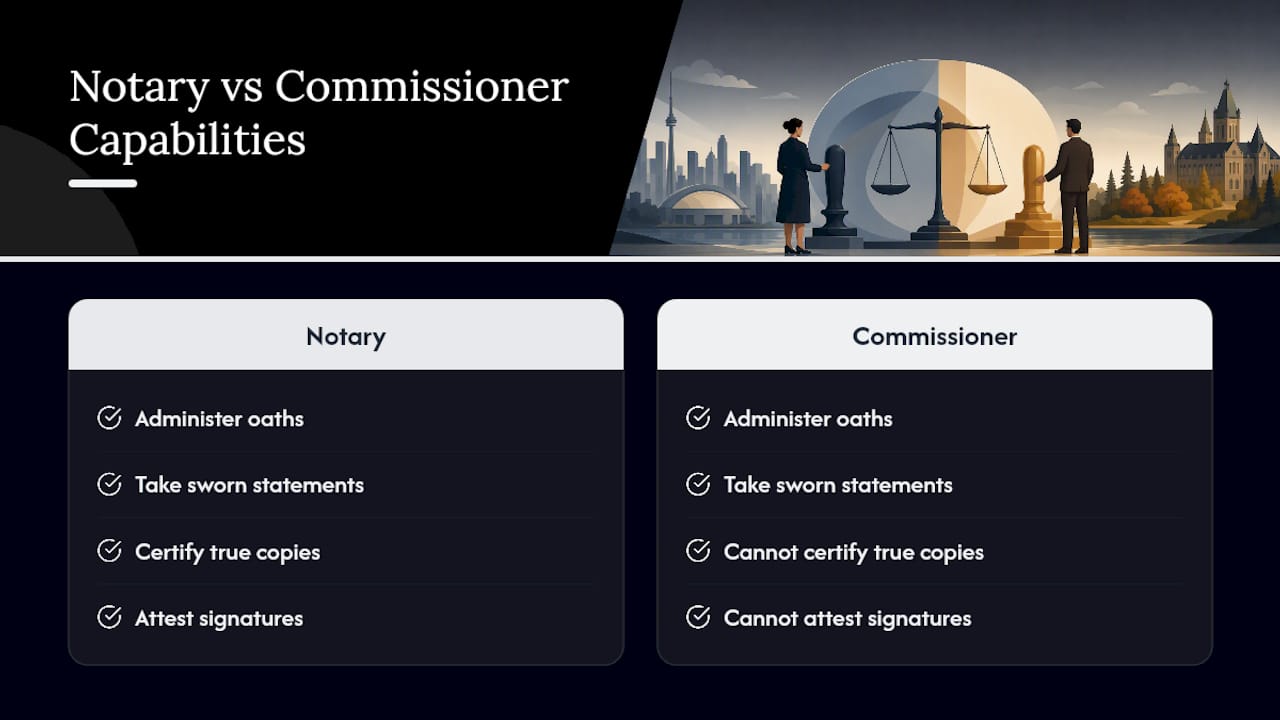
The gap matters most when a document is headed to a foreign bank, embassy, or government office that specifically requires notarization. A commissioner's stamp simply won't satisfy that requirement, no matter how properly the signing was witnessed.
The ethical rule running underneath both roles is the same: a notary or commissioner shouldn't act on a document where they hold a personal or financial interest. That's the conflict-of-interest concern at the heart of Ontario witness ethics, whether it's a will, a statutory declaration, or a business affidavit.
Pro Tip: Before you book a signing, ask the official directly which appointment they hold, notary or commissioner, and confirm your receiving party (bank, embassy, government office) actually requires the notarized version rather than a commissioned one.
How to Prevent Witness or Notary Conflicts Before You Sign
Reporting a conflict of interest in Ontario after the fact is expensive. Preventing one costs nothing but a little planning.
- Confirm every beneficiary named in the document before you choose witnesses, so you know exactly who's disqualified.
- Rule out spouses of beneficiaries too. The disqualification follows the marital connection, not just the name on the gift.
- Use two independent adult witnesses with no financial or family stake in the outcome.
- Verify the official's actual appointment. Ask whether they're a notary public or a commissioner, and confirm that matches what your receiving institution needs.
- Check identification for both witnesses and the signer, and keep a written or digital record of how the signing happened.
- Sign an Affidavit of Execution immediately, while everyone is still present, rather than trying to reconstruct the circumstances weeks later.
- Preserve contact details for both witnesses in case probate or a dispute requires their testimony down the line.
That fourth and fifth step matter more than people think. Practitioner guidance on Affidavits of Execution treats that document as the single most useful piece of evidence if a will is ever challenged, precisely because it's created in the moment rather than reconstructed from memory.
Pro Tip: For online notarizations, hold onto the session's audit trail, timestamp, and recorded identity verification. That record is what proves the signing happened properly if anyone questions it later.
What Happens If a Conflict Surfaces After the Document Is Signed
If a beneficiary-witness problem turns up after signing, the gift to that witness is presumptively void, and the rest of the document typically survives intact. Whether the gift can be revived depends on convincing a court that no undue influence occurred, which is a fact-specific and sometimes costly fight.
Move fast on preservation:
- Locate the Affidavit of Execution, if one exists, and don't let it disappear
- Get contact information for both witnesses while memories are fresh
- Gather any contemporaneous notes, texts, or lawful recordings from the day of signing
Whether it's worth consulting a lawyer usually comes down to the size of the estate and how likely a dispute is. A small, uncontested estate might not justify a court application under the SLRA. A larger estate, or one where family relationships are already strained, almost always does. Either way, expect the process to take months rather than weeks, and expect legal costs that make prevention look cheap by comparison.
Ken's Take: Why Neutral Witnesses Protect Everyone, Not Just the Signer
The mistake I see most often isn't malice. It's convenience: people grab whoever's in the room, usually a family member, without checking who benefits under the document. Identity verification and logging the signing session creates a real record if anyone ever questions it. Choose neutral witnesses, document the moment properly, and you've removed the single biggest source of future disputes.
— Ken
Get Your Documents Notarized Without the Guesswork
Choosing the wrong witness or the wrong official is an easy mistake to make on your own, and it's exactly the kind of problem a properly run notarization session is built to prevent. Theonlinenotary handles online notary and commissioning services for individuals and businesses across Ontario, with identity verification and an audit trail built into every remote session, so there's a real record if a signing is ever questioned later.

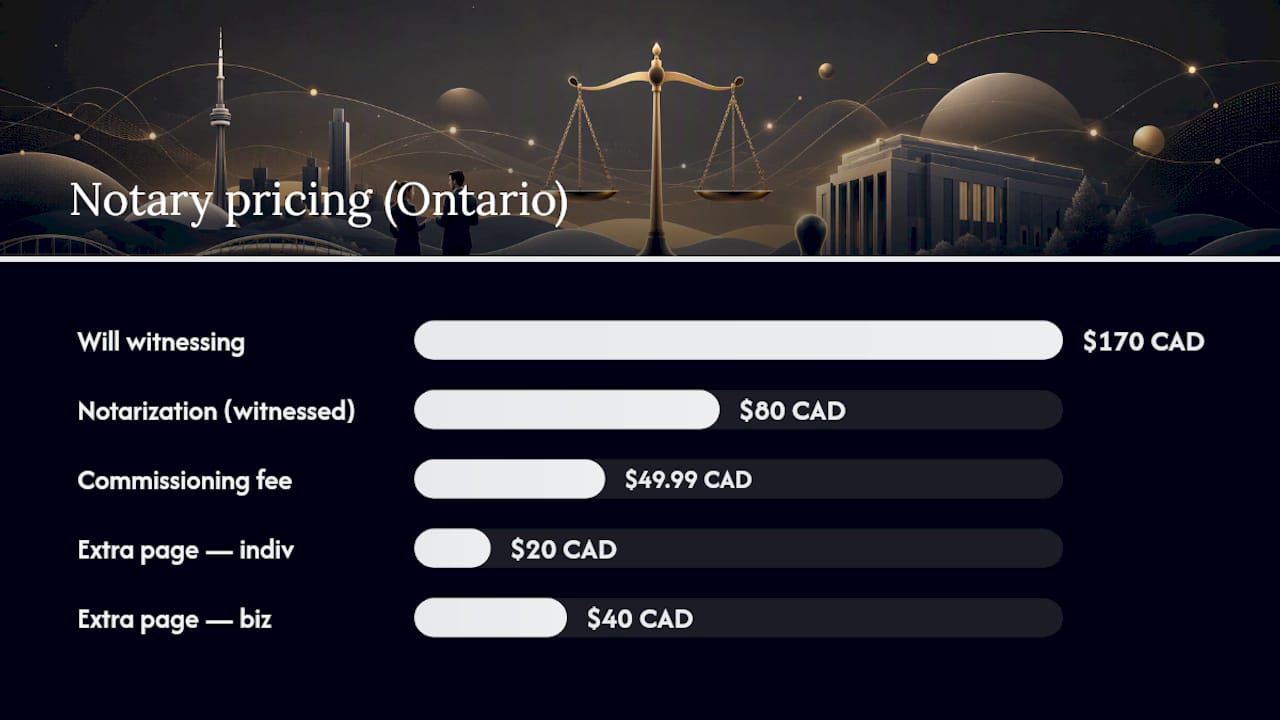
If you're preparing a will or power of attorney, Theonlinenotary offers witnessing for wills and POAs at a flat $170 CAD per will, with straight notarization of an already-witnessed will or POA priced at $80 CAD. Individuals booking online commissioning pay $49.99 CAD per document, with additional pages at $20 CAD each; businesses pay the same $49.99 CAD document fee with $40 CAD per extra page. Certified true copies are also available in person in Brampton for those who need a physical certification rather than a remote one.
Before your session, review Theonlinenotary's preparation guide so you arrive with the right identification and know what to expect. When you're ready, book your appointment directly through Theonlinenotary and get a properly documented, conflict-free signing on the record.
Where These Rules Come From
The rules covered here trace back to two Ontario statutes: the Succession Law Reform Act, which governs interested witnesses and gift validation, and the Notaries Act, which sets out notary powers. The Law Society of Ontario is the place to confirm whether a lawyer or paralegal holds an active license.
This article is general information, not a substitute for advice from a qualified lawyer. Consult a qualified legal professional about your own circumstances before acting on anything here.
Sources
- Succession Law Reform Act (Ontario)
- Who can notarize a document in Ontario? (Mayo Law, 2026)
- Who can witness a will in Ontario? (Probate Law Group)
- Can a beneficiary also be a witness? (Hull and Hull LLP)
FAQ
Does a beneficiary witnessing a will void the entire document?
No. Only the gift to that beneficiary (and their spouse) is presumptively void under the Succession Law Reform Act. The rest of the will remains valid, and courts can occasionally validate the specific gift if no undue influence is proven.
Can a commissioner certify a true copy of a document in Ontario?
No. Only an appointed notary public can certify true copies; a commissioner for taking affidavits can administer oaths but lacks that certification power, which matters for documents headed abroad.
Who is disqualified from acting as a will witness in Ontario?
Anyone under 18, anyone lacking mental capacity, and any beneficiary or their spouse is disqualified. Standard guidance recommends two independent, disinterested witnesses plus a signed Affidavit of Execution.
What does Theonlinenotary charge for witnessing a will or POA?
Theonlinenotary charges $170 CAD per will for witnessing services and $80 CAD for notarizing an already-witnessed will or POA, both listed on its services page.
Can a court fix a will that was witnessed incorrectly?
Sometimes, under Section 21.1's substantial compliance provision, if the evidence shows the document reflects the testator's fixed and final intentions. Case law confirms this outcome is possible but fact-dependent, not guaranteed, so it shouldn't be the backup plan.